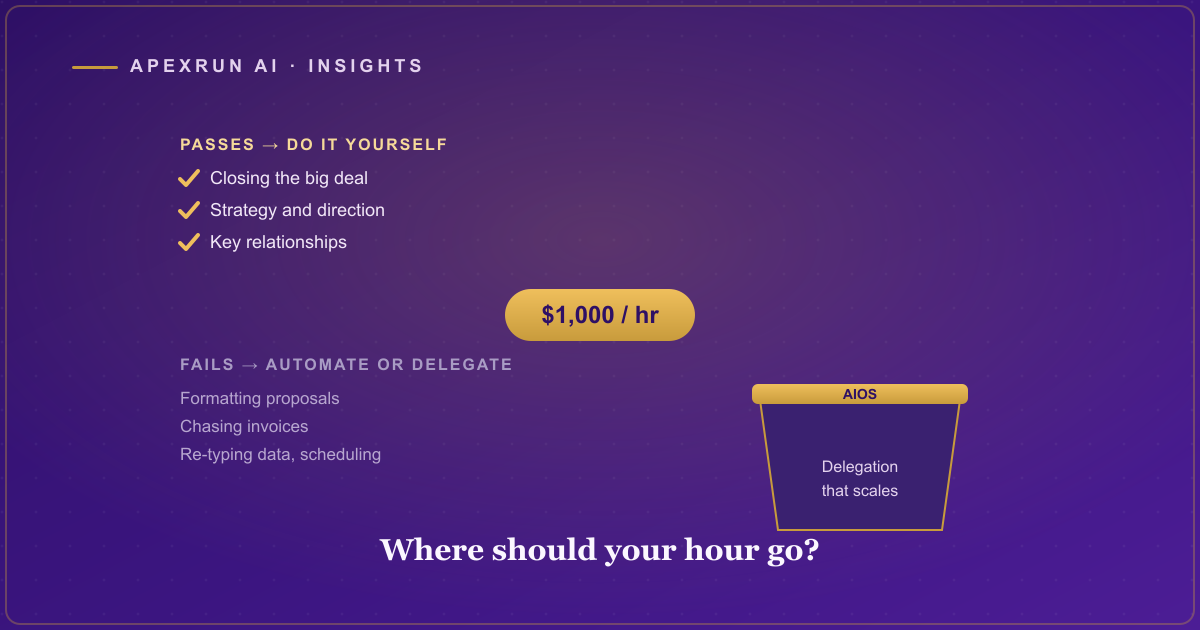
Here is a test that will change how you spend your week, and it takes one question. Look at the task in front of you and ask: is this worth a thousand dollars an hour? The value of your time as a business owner is not what you charge a client and it is not your salary divided by your hours. It is the value of the most important thing you could be doing with that hour, and the most important thing an owner can do is almost always worth far more than the busywork sitting on their desk. The thousand-dollar-an-hour test is a blunt filter for telling the two apart, and once you start applying it, most of your day fails.
That is not an insult. It is the point. The reason the test works is that it forces an honest answer to a question owners avoid, which is whether the thing they are about to spend an hour on is actually the highest use of that hour or just the thing that was easiest to pick up. Almost always it is the second one, and almost always the highest use was something else entirely.
What a thousand-dollar hour actually looks like
Be concrete about what passes the test, because the number is a stand-in for a category, not a literal rate. The work worth your top rate is the work only you can do and the work that moves the business the most. Closing a significant deal. Setting the strategy for the next year. Building the relationship with the client or partner who represents real money. Making the hire that changes the team. Deciding what the business does not do. These hours are worth enormous amounts because they compound, they set the direction that everything else follows, and nobody else in the building can do them in your place.
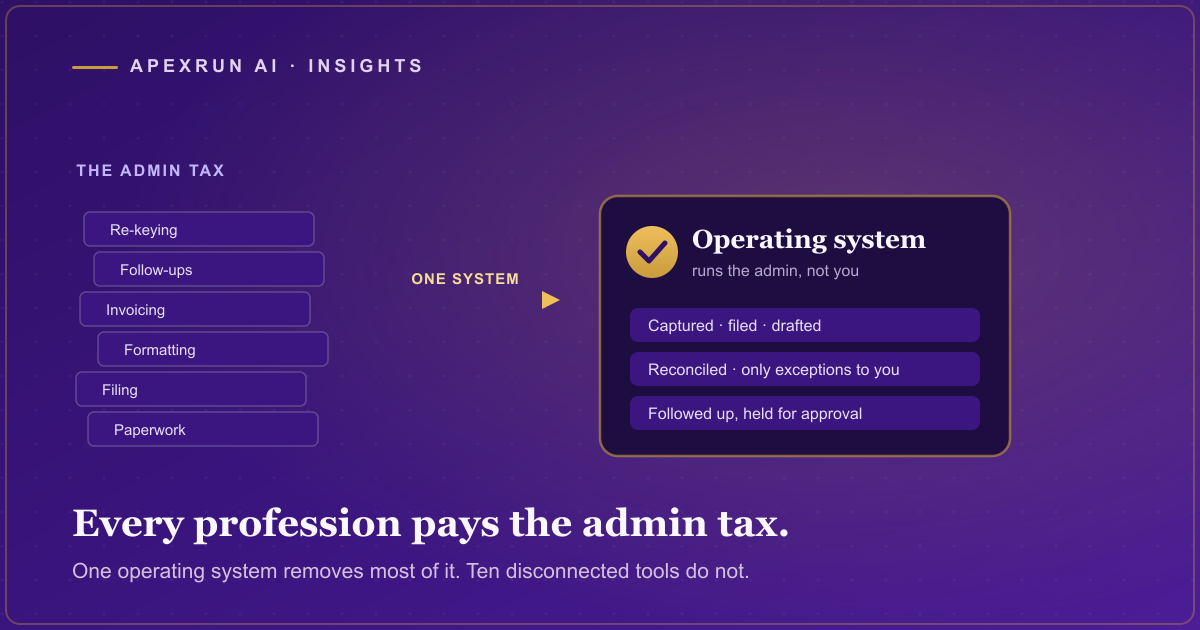
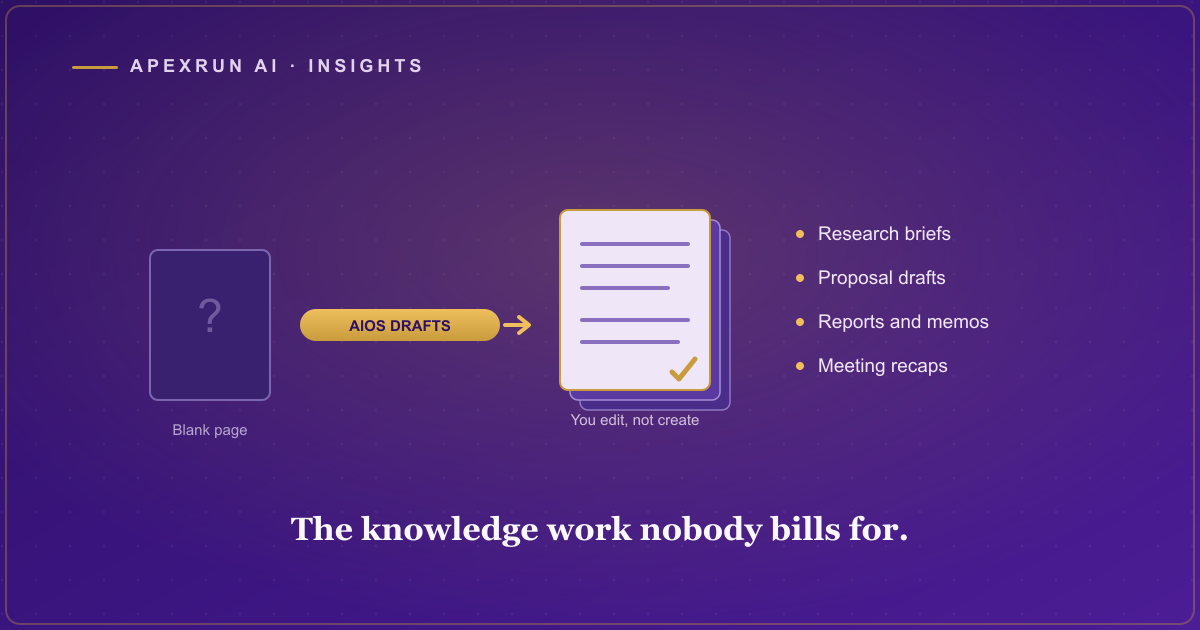
Now the work that fails. Formatting the proposal. Chasing the invoice for the third time. Re-typing data from one system into another. Drafting the routine report from scratch. Scheduling the meeting. Writing the follow-up email you have written a hundred times. None of this is worthless. All of it has to happen. But none of it is worth a thousand dollars an hour, and every hour you spend on it is an hour not spent on the work that is. This is the same split I laid out in high-value versus low-value hours, the test is just the fastest way to apply it in the moment.
The trap: cheap work feels productive
Here is why owners keep failing their own test even after they understand it. The low-value work feels good to do. It is concrete, it has a clear finish, you can check it off, and it produces the pleasant sensation of having been busy and useful. The thousand-dollar work is the opposite: it is ambiguous, it has no clean finish, it is often uncomfortable, and it does not give you the tidy hit of a completed task. So the human brain, offered a choice between a satisfying small task and a daunting large one, reaches for the small one, and calls it work.
Multiply that across every day and you get the owner who is constantly busy, always working, and somehow never getting to the things that would actually grow the business. They are not lazy. They are the hardest-working person in the company. They are just spending their most valuable hours on their least valuable work, because the least valuable work is the most comfortable, and nobody built a filter to stop them. The test is that filter. When you catch yourself reaching for the easy task, ask if it is worth a thousand dollars an hour, and the honest answer usually sends you back to the harder, more valuable thing you were avoiding.
What you do with the tasks that fail
The test is only useful if you act on it, and the action is simple to say: if a task is not worth your top rate, it should not be done by you at your top rate. It should be automated or delegated. That is the entire operating instruction. Every hour of failed-the-test work is an hour to hand off, and the only question is to what.
Traditionally the answer was delegation to a person, and that works, but it runs into limits. People cost money, take time to train, have their own capacity ceilings, and can only absorb so much of the low-value work before you are managing them instead of doing your own thousand-dollar hours. Delegation to humans helps, but it does not scale cleanly, and past a certain point the management overhead of delegating eats into the very hours you were trying to free.
This is where a system changes the equation. An AI operating system, an AIOS, is delegation that scales without the ceiling, because handing another task to it does not add a salary, a training cost, or a management burden. The drafting, the follow-up, the data movement, the routine reports, all the work that fails the thousand-dollar test can be handed to a system that runs it consistently, around the clock, without you managing it. It is the delegation you always wanted and could never quite afford to build out with people. You can see how the pieces bundle together on the packages page, rather than being sold to you as a dozen tools you would then have to run yourself.
The compounding on the other side
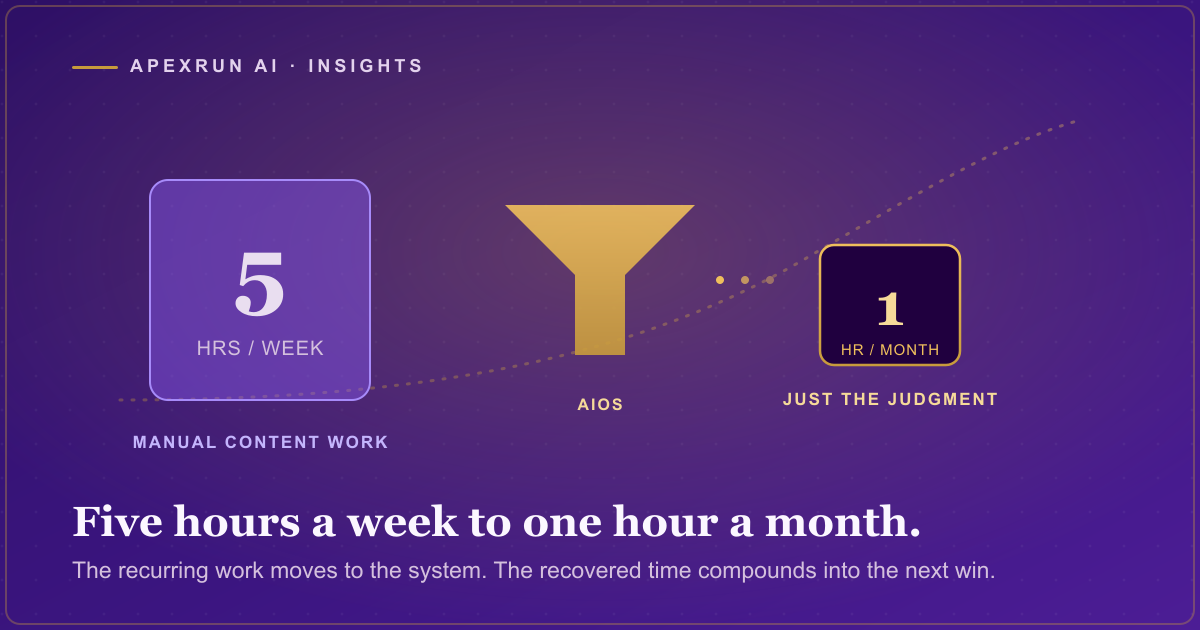
Play it forward. Suppose the test frees up ten hours a week that were going into work below your rate [ESTIMATED, varies by owner], and you redirect even half of those into genuine thousand-dollar hours, the deals, the strategy, the relationships. That is not a small improvement to your week. That is a structural change to what your business becomes, because the high-value hours are the ones that compound, and you have just multiplied them. The owner who protects their thousand-dollar hours and automates the rest is not working less, they are working on entirely different things, and it shows up in the growth. The same pattern holds across every kind of business, which you can see on the industries we work with.
Where to start
Do not try to reorganize your whole week from memory. Spend two days actually noticing which tasks pass the test and which fail, and you will have a list of exactly what to hand off, ordered by how much of your time it is stealing.
That list is what the Free CEO Audit builds with you, faster. In one hour, direct with the decision-maker, we sort your real work into what only you should do and what a system should take, and hand you a prioritized plan for automating the tasks that fail your thousand-dollar test, so you get those hours back for the work that is actually worth your rate, before you spend a dollar building anything.