
Every AI automation pitch sounds the same right now. Same promises, same screenshots, same claim about hours saved.
Here is how to tell them apart.
1. Ask who owns the accounts
If the answer is anything other than you, walk.
Your phone number, your calendar, your CRM, your customer records. All of it should sit in accounts with your name on the billing. A partner who holds the keys is not a partner. They are a landlord, and the rent goes up when you try to leave.
Ask it directly: if we stop working together on Friday, what do I still have on Monday?
2. Make them show you a live system, not a deck
A slide showing what AI could do is worth nothing. Anyone can build that in an afternoon.
Ask to call something. Ask to log into something. If they cannot put a working system in front of you inside the first two conversations, they do not have one.
And when they do put it in front of you, try to break it. Push it hard for a price it should not give you. Talk over it. Ask it something outside its job and watch what it does. A system that only works when you are polite to it will not survive your actual customers.
3. Ask what it will not do
This is the question that separates the honest ones.
Every real system has edges. It will not handle the caller who is furious about an invoice. It will not price a job it has never seen. It will not make a judgement call that needs you.
If they tell you it handles everything, they have either not built it or not tested it.
4. Find out where your data goes
For most GTA businesses this is a question about PIPEDA and about your clients. If you handle health information, legal files, or financial records, it stops being a preference and starts being an obligation.
Ask where the data is processed and whether it can stay in Canada. Ask whether the sensitive parts can run on hardware you own rather than someone else’s cloud. If the person cannot answer that clearly, they have not thought about it.
5. Ask them to say no to something
A good partner will tell you which parts of your business should not be automated yet.
If everything you mention gets an enthusiastic yes, you are talking to someone selling hours rather than outcomes. The most useful thing anyone told me about my own operations was which piece to leave alone.
6. Look at how they price the first step
Not the number. The structure.
An engagement that starts with a proper look at your operations, before anything is built, is one that expects to be measured. An engagement that starts with a build is one that has already decided what you need.
The uncomfortable one
Ask how many businesses they have actually deployed for, and then ask to speak to one.
Not a testimonial on a page. A phone call with an owner who will tell you what went wrong as well as what went right. If nobody will take that call, you have your answer.
Where to start
Pick two questions from this list and put them to whoever you are already talking to. You will learn more in ten minutes than in three more sales calls.
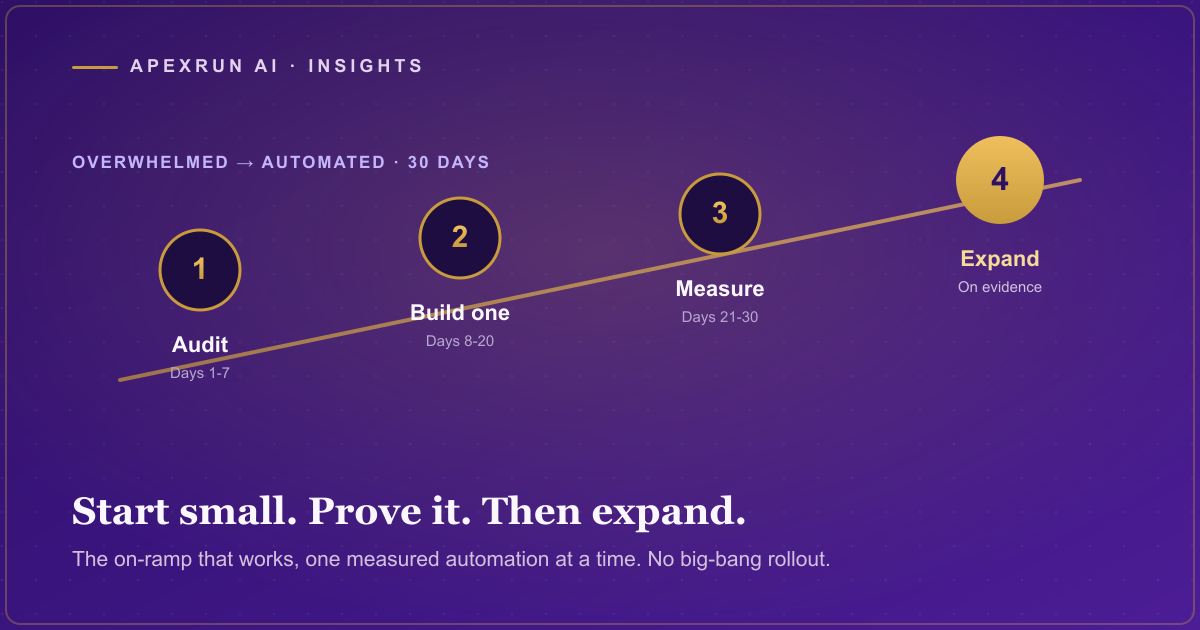
If you would like the same questions turned on your own operations, the free CEO audit is sixty minutes and you leave with a written blueprint of what to automate and in what order. It is yours to keep whether or not we work together.