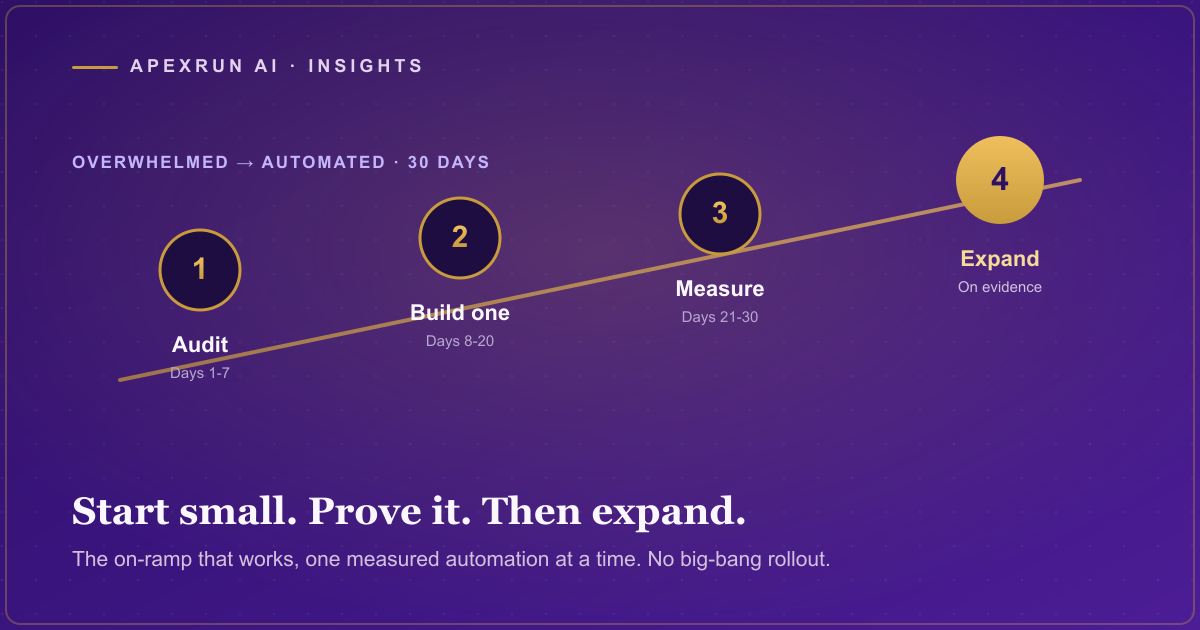
The hardest part of AI is not the technology. It is the first step. Most owners have read enough to know they are leaving time and money on the table, and are stuck anyway, because the space is a wall of noise with no obvious place to begin and a hundred tools all shouting that they are the answer. So they do nothing, month after month, and the busywork keeps compounding. If that is you, here is how to start with AI automation without gambling, without a giant rollout, and without spending a dollar before you know it will pay back. It is a 30-day on-ramp with four steps, and it is deliberately boring, because the boring version is the one that actually works.
This is the last article in this series, so let me make it the one you can act on. Everything else we have written points here: to the question of what to do on Monday.
How to start with AI automation without betting the business
The single biggest mistake owners make is trying to automate everything at once. They get excited, or they get sold, and they sign up for a sweeping transformation that touches every part of the operation on day one. It almost always stalls, because a big-bang rollout has too many moving parts, no early proof, and no way to tell what is working. When it wobbles, the whole thing gets abandoned, and the owner walks away concluding that AI does not work for their business. It was not the AI. It was the shape of the attempt.
The sane way to start with AI automation is the opposite: pick the single highest-return task, automate just that one, prove it in the real operation, and only then expand. Small, proven, then bigger. This is the same audit-to-autonomy progression we run in every real deployment, and it works because each step earns the next. You are never exposed to a large bet, because you are only ever building the next thing the last thing paid for. Thirty days is enough to get through the first full loop and come out the other side with something running and measured.
Days 1 to 7: audit before you build
You cannot automate what you have not measured, and the reason most first attempts miss is that they skip straight to a tool without knowing which task is actually the expensive one. So the first week is not about software at all. It is about looking honestly at where your time and money go.
Write down what actually happens in a normal week, task by task, and mark each one on two questions: how much of your expensive time does it eat, and how repetitive and rule-based is it. The tasks that are both costly and repetitive are your candidates. Somewhere in that short list is one task that is bleeding more than the rest, usually something high-volume and mind-numbing that you or a skilled person keeps doing by hand. That is your phase-one target. You are not trying to find everything. You are trying to find the one thing whose automation would pay back fastest, because that is the build that funds all the others and proves the idea to yourself.
Days 8 to 20: build one high-impact automation
Now you build exactly one thing. Not a platform. Not a transformation. One automation, aimed at the single task the audit surfaced, done properly, with a human approval gate wherever a mistake would be costly.
The discipline here is restraint. Resist the urge to bolt on the other five ideas the audit gave you, because scope is what kills first builds. Take the one task, connect the flow end to end, and get it running against real work. The intake that never gets answered fast enough, now captured and drafted automatically for your sign-off. The report that eats your evenings, now generated from your notes and waiting for your review. The reconciliation that steals a day a month, now done with only the exceptions surfaced to you. Whatever your one task is, the goal for these two weeks is simple: it runs, you trust it, and it is off your plate except for the decisions that genuinely need you. One working automation beats ten half-configured tools every time, and it gives you the thing a big-bang rollout never does, which is proof.
Days 21 to 30: measure honestly, then decide
The final stretch is measurement, and this is the step almost everyone skips, which is why almost everyone is unsure whether their AI is worth it. You cannot expand on a feeling. You expand on a number.
Measure the one thing you built against the one thing you already knew: how many hours a week did this task used to cost, and how many does it cost now. Be honest, including about the time you still spend approving and correcting it, because a real number is the only thing that tells you whether to expand or adjust. In most cases the answer is clear within days, because a well-chosen first task gives back hours you can feel. Once you have that number, the decision to move to phase two makes itself, and it is now an evidence-based decision rather than another leap of faith. You are no longer wondering whether automation works for you. You have run the experiment in your own business and you have the result in hand. This is what turns five hours of work into one, one measured task at a time.
After 30 days: expand at the pace the results allow
At the end of the month you are in a fundamentally different position than the owner who tried to boil the ocean. You have one automation running, one honest measurement, and a clear sense of whether the return is there. From here, expansion is calm, because it is funded and proven. You add the second task, then the third, each one earning its place before the next begins, until the system is running a large share of your admin and the operation holds together without you being the glue.
That measured, connected end state is what an AI operating system actually is, and it is worth understanding that you do not arrive there by buying it whole on day one. You arrive by walking the on-ramp, one proven step at a time, which is exactly why the same approach works across wildly different industries. The businesses that win with AI are almost never the ones that moved fastest. They are the ones that started small, measured honestly, and expanded on evidence.
The one step that starts the clock
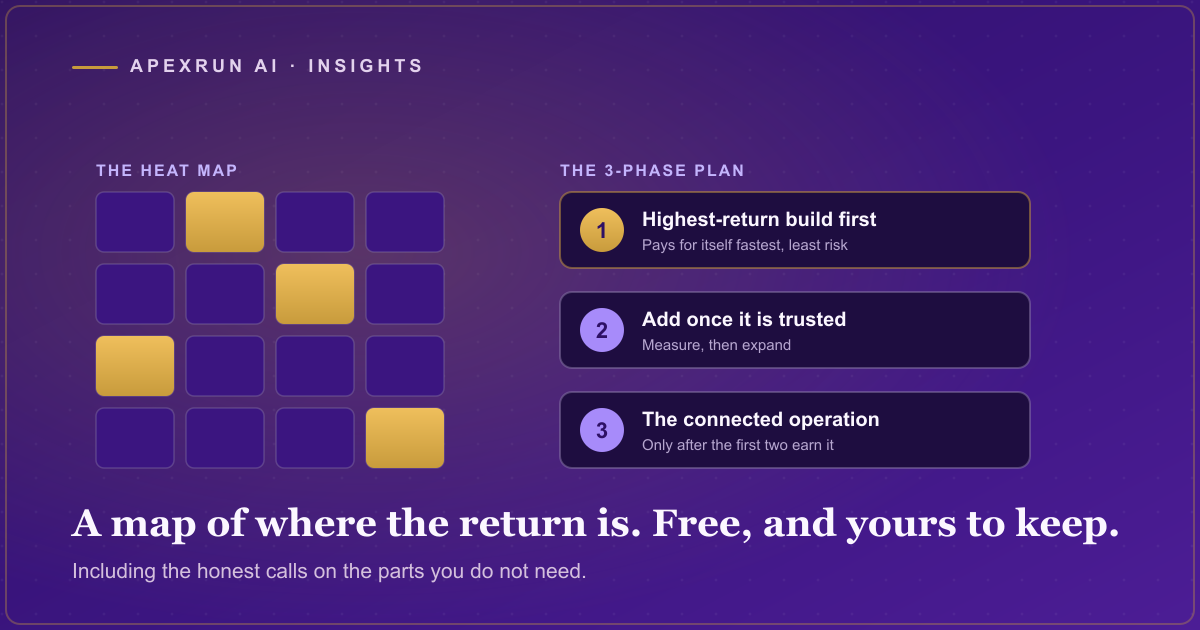
The whole path hinges on getting the first week right, because a badly chosen phase-one task wastes the month. That is precisely what the Free CEO Audit compresses into a single hour. Direct with the decision-maker, we do the days 1 to 7 work with you: map where your time goes, find the one highest-return task to automate first, and hand you the phased plan, so your 30 days start pointed at the right target instead of a guess.
You have spent long enough knowing you should do something about this and not knowing where to begin. Now you know where. Book the hour, get your first task identified, and start the clock. Thirty days from now you can be the owner with one thing proven and running, instead of the one still reading about it.