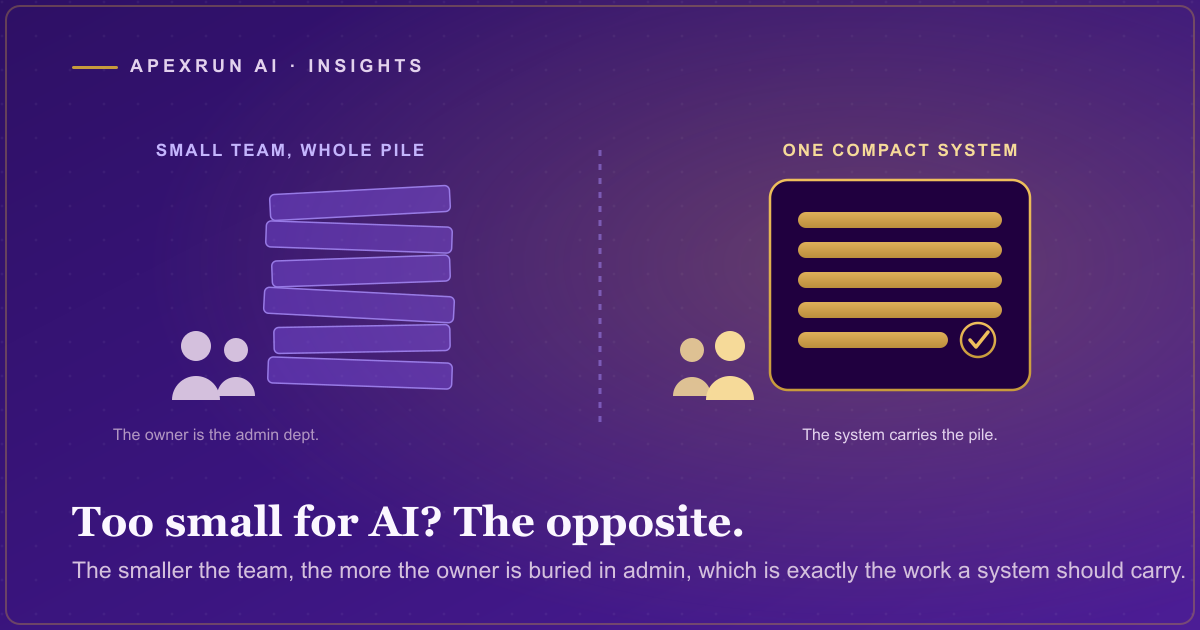
The question I hear most from owners of small companies is some version of “isn’t this AI stuff really for the big players?” It is a fair thing to ask, and the honest answer is the opposite of what most people assume. AI for small business owners is not a scaled-down version of what a large company does. In many ways the small business has more to gain, not less, because of one fact that the size actually makes worse: in a small company, the owner is the one doing the admin. There is no operations department to absorb it. There is no assistant, no back office, no team of coordinators. There is you, and the pile.
So when someone tells me their business is too small for this, what they are usually describing is a business where the most expensive person in the building, the owner, spends half their week on work that a first-week hire could do. That is not a reason to skip a system. That is the single strongest reason to want one.
Why AI for small business owners pays off harder than it does for the enterprise
A large company already has leverage. It has departments, layers, and staff whose entire job is to handle the recurring work. When a big firm automates a process, it is shaving cost off a machine that already runs without the CEO touching it. The savings are real but diffuse, spread across a payroll of people who were doing the work anyway.
A small business has no such buffer. The recurring work does not land on a department. It lands on the owner, personally, on top of the actual job of running and growing the company. Every hour the owner spends chasing an invoice, re-typing a client’s details, booking an appointment, or drafting the same follow-up for the tenth time is an hour not spent on the work only the owner can do: winning the client, doing the craft, making the call that moves the business. In a two-person shop, the cost of the owner buried in admin is not a rounding error on a big payroll. It is the ceiling on the whole business.
That is why the math runs the other way from what people expect. The smaller the team, the higher the share of low-value work sitting on the highest-value person, and the bigger the return when a system lifts it off. I have written before about the trap of doing twenty-dollar work in a four-hundred-dollar seat, and nowhere is that trap tighter than in a small business, because there is nobody else to hand the twenty-dollar work to.
”Too small” usually means “no time to look,” not “nothing to gain”
When an owner says the business is too small, dig a little and it is rarely about the size. It is about bandwidth. They are already underwater, working evenings, and the idea of adding a technology project to the pile sounds like one more thing they do not have time for. That instinct is right about one thing and wrong about the conclusion. Yes, you do not have time to run a sprawling software rollout. No, that does not mean you have nothing to gain. It means the opposite: you are exactly the person whose time is being wasted the most.
The other quiet worry is money. There is an assumption that this kind of thing costs what a big company pays, with an IT team to run it. It does not have to. The point of an AI operating system is that it is a workforce you own rather than a stack of subscriptions you rent, and for a small business the right first step is not a large build. It is finding the one or two pieces of recurring work that are eating the most of the owner’s week and taking those off the desk first.
The mistake to avoid: do not try to automate everything at once
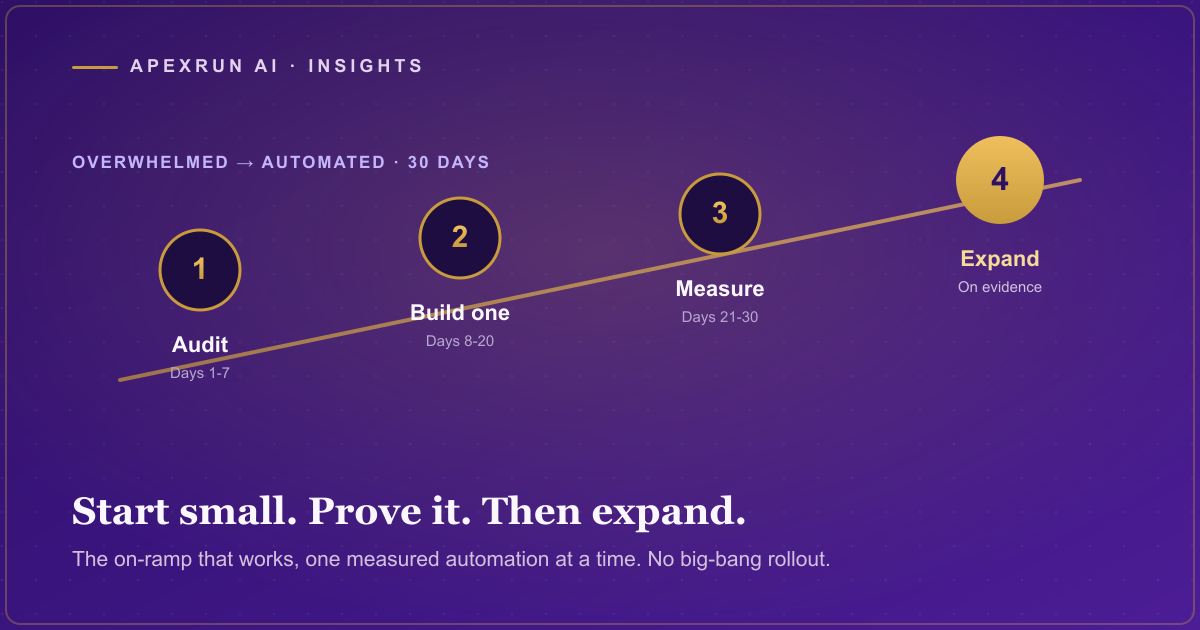
Here is where small businesses go wrong when they finally decide to act. They try to fix the whole thing in one go, get overwhelmed, and quit. That is the wrong shape. The right shape is to start where the pain is worst and prove it works before you widen it.
For most small businesses, the worst leak is in one of three places. It is the intake and follow-up on new leads, where enquiries go cold because the owner was on a job and did not reply fast enough. It is the scheduling and reminders, the endless back-and-forth of booking and the no-shows that follow. Or it is the money side, the invoicing and chasing that slips because the owner would rather do almost anything else. Pick the one that costs you the most and start there. One narrow win that gives you back three or four hours a week is worth more than an ambitious plan that never ships, and it funds the confidence to do the next piece.
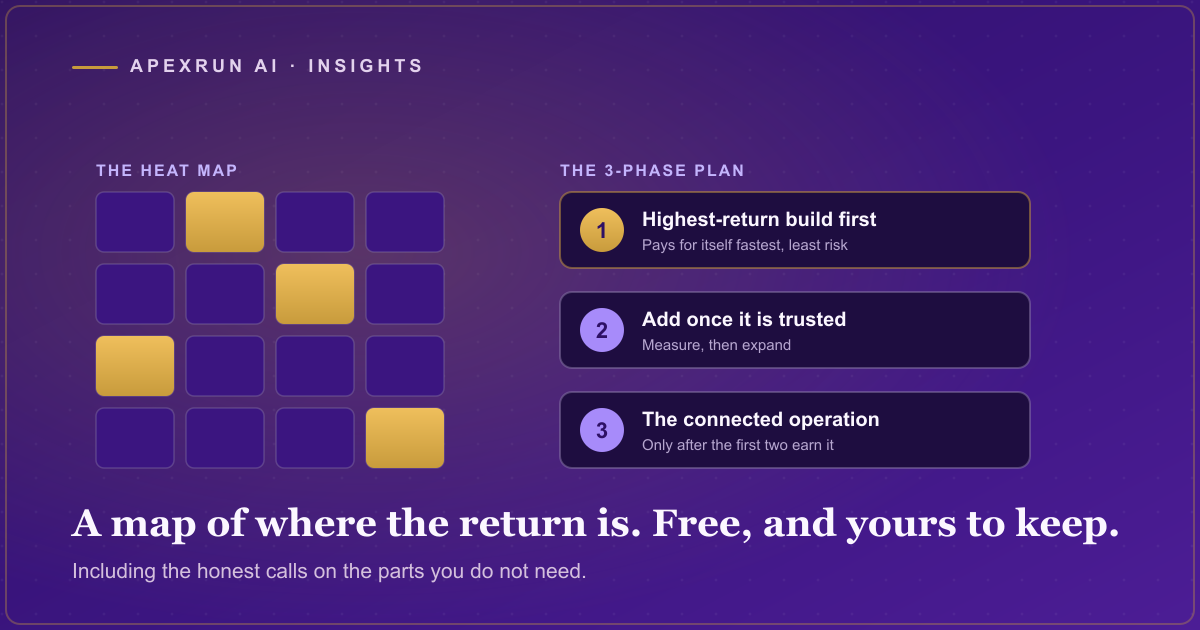
This is the same principle behind every serious deployment, whatever the size of the company. You map where the hours actually go, you take the highest-cost, lowest-judgment work off the human first, and you widen from there. The industries breakdown shows how that plays out profession by profession, and the pattern is the same whether the business has two people or two hundred: the recurring process work is the target, and the human keeps the judgment.
The honest answer
So, is your business too small for AI? No. If you are a solo owner or a small team, you are not too small. You are the case with the most to gain, because the admin that a bigger company spreads across staff is sitting entirely on you, and you are the most expensive and most irreplaceable person in the building. Being small does not disqualify you. It sharpens the argument.
What is true is that a small business cannot afford to get this wrong, waste money on the wrong build, or sink weeks into a project that does not pay off. That is precisely why the first move is not to build anything. It is to look clearly at where your week goes.
That look is the Free CEO Audit. In one hour, direct with the decision-maker, we walk through where your hours actually go, identify the one or two pieces of recurring work a system should carry first, and hand you a prioritized plan, so you know exactly what to turn on and in what order before you spend a dollar building it. Most small-business owners come out of that hour realizing the question was never whether they were too small. It was how much of their own week they had been quietly giving away.