Picture a doctor. She trained for a decade, she carries the risk, and her time in front of a patient is worth something close to $400 an hour once you account for what the practice bills against it. Now watch what she actually does at 6:40 in the evening. She is writing up notes. She is reformatting a referral letter. She is chasing a lab result and re-typing it into a form. She is answering an email that a well-briefed assistant could have handled in ninety seconds.
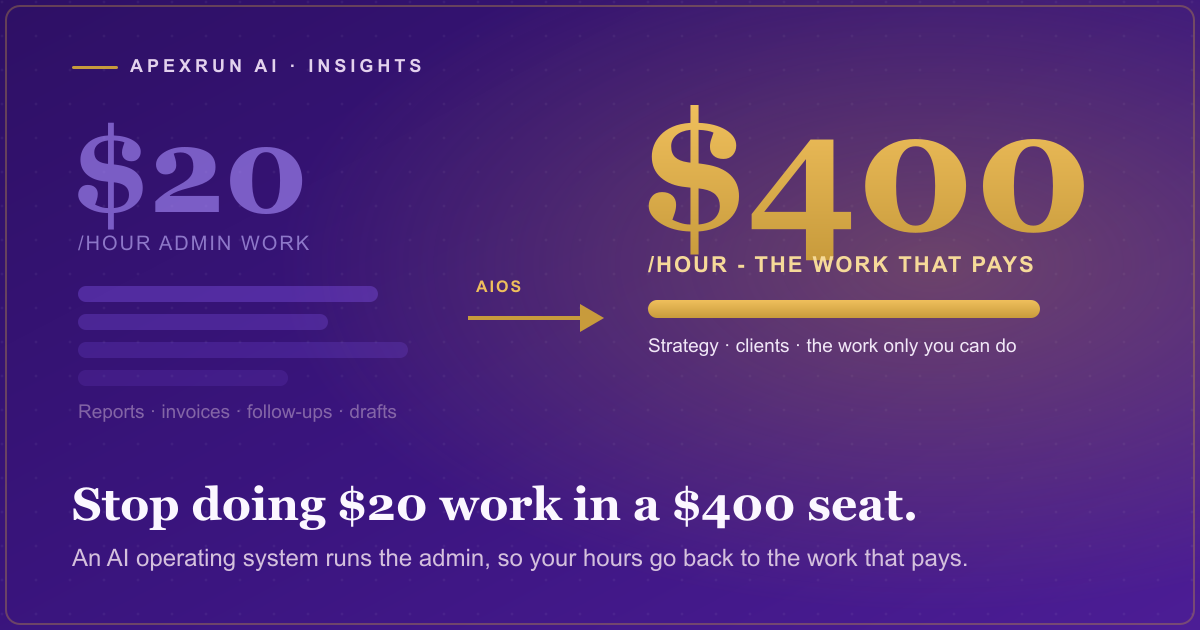
That doctor is doing $20 work in a $400 seat. And she is not unusual. She is the norm.
The most expensive clerk in the building
Here is the uncomfortable math. If your professional time is worth $400 an hour and you spend two hours a day on administrative work, you are not saving money by doing it yourself. You are burning $800 a day, or roughly $200,000 a year [ESTIMATED, based on 250 working days], to avoid hiring help you think you cannot afford. You have quietly made yourself the most expensive clerk in the building.
This is the trap that catches almost every high-value professional. Lawyers draft their own engagement letters and reconcile their own trust ledgers. Accountants re-key figures between systems during the exact weeks they should be advising clients. Consultants spend Friday building the deck instead of selling the next engagement. Clinic owners do payroll at midnight. Agency principals write status reports nobody reads. Trades owners quote jobs from the truck at 9 PM because the day was full of actual work.
None of these people have a demand problem. They have a delivery-overhead problem. The work that pays gets squeezed into the margins because the work that does not pay expanded to fill the day.
The work splits cleanly into two piles
If you write down everything you did last week and put a dollar figure next to each task, the list separates fast.
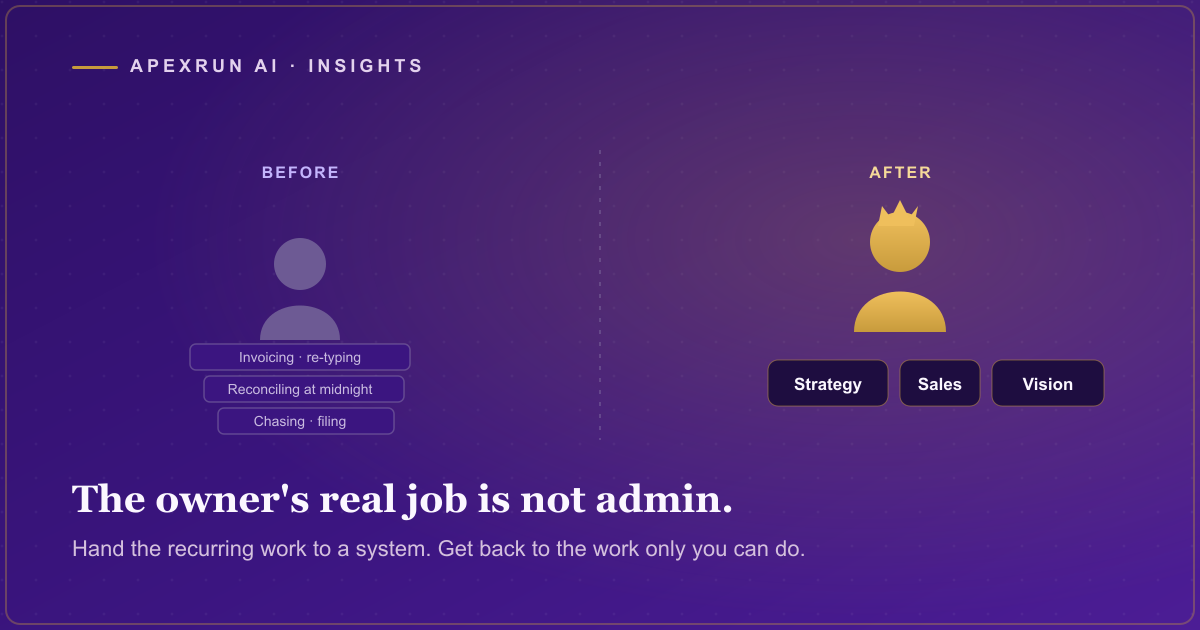
One pile is the work only you can do. Diagnosing the hard case. Winning the client. Making the judgment call that carries real consequences. Building the relationship. This is the $400 pile, and it is the entire reason your rate is what it is.
The other pile is everything around it. Reports. Invoices. Document formatting. Financial reconciliation. Research you already know how to do. First drafts. Follow-up emails. Scheduling. Data entry. Intake. This is the $20 pile. It has to happen, but there is nothing about it that requires your license, your experience, or your judgment.
Most professionals try to fix this by working harder or by hiring a person. Working harder does not scale, because you only have so many hours and the admin grows with the practice. Hiring a person helps, but a person is expensive, needs managing, takes holidays, and still hands the interesting-but-tedious 20 percent back to you because it needs your input to start.
There is a third option now, and it is the one pulling ahead.
An AI operating system is a workforce that runs the $20 pile
Most owners have already bought some AI. A note-taker. A chatbot. A writing assistant. Six months later they are still the bottleneck, because a pile of disconnected tools is not a system. Each tool solves one task and creates two new ones around it: now someone has to copy the output somewhere, decide what to do with it, and remember to follow up.
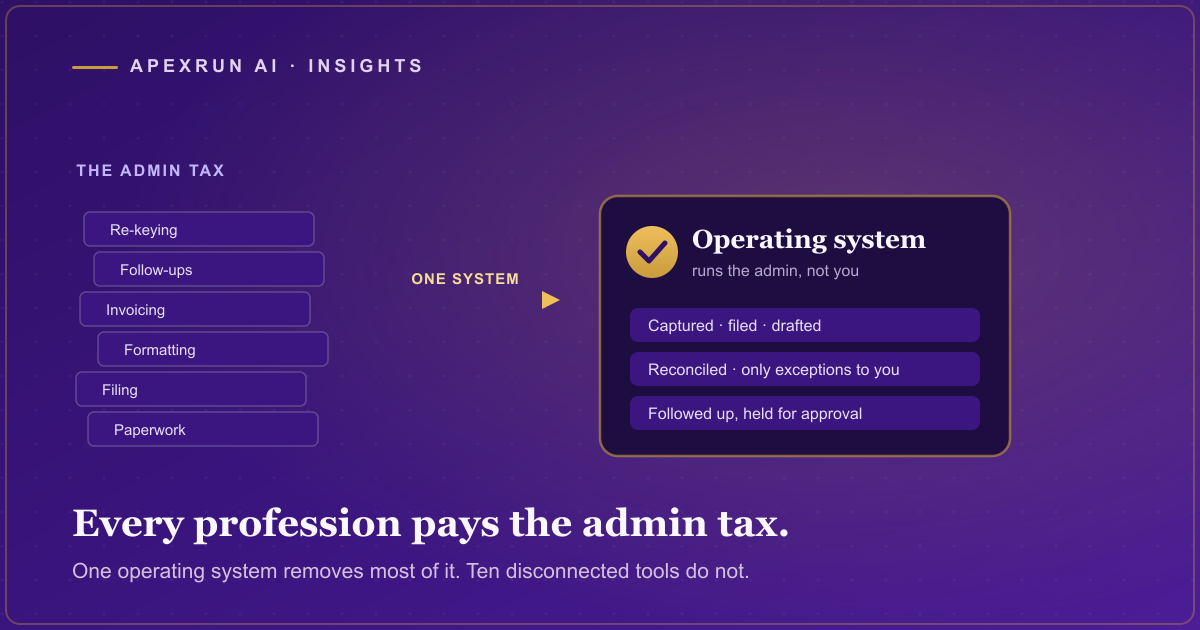
An AI operating system, what we call an AIOS, is different. It does not solve one task in isolation. It connects the whole flow and runs it. The intake comes in, the system captures it, files it, drafts the response, updates the record, books the next step, and loops you in only where your judgment actually matters. You stop holding the operation together in your head.
In a professional practice, an AIOS can take on a large share of the $20 pile. It drafts the report from your notes and waits for your sign-off. It generates the invoice from the logged time. It pulls the research into a briefing. It reconciles the numbers and flags only the exceptions. It writes the follow-up and holds it for your approval. It handles intake and scheduling without a human touching the calendar. Wherever a mistake would be costly, a human approval gate stays in place, so you are reviewing work instead of producing it from scratch.
Think of it as a workforce you do not have to recruit, train, or manage, working the recurring admin at a cost that does not move with headcount. In the practices we deploy it into, it takes on the majority of that repetitive load [ESTIMATED, varies by practice], which is the difference between finishing at 6 PM having done your actual job and finishing at 8 PM having done everyone else’s.
Do the reclaim math on your own week
Run the numbers on yourself, not on a case study.
Take the hours you personally spend on the $20 pile each week. Say it is ten. If an AIOS absorbs the bulk of that and hands you back, conservatively, seven hours, those seven hours do not vanish into more admin. They move to the $400 pile. At a $400 rate, seven reclaimed hours a week is $2,800 of capacity you did not have, every week, roughly $140,000 a year [ESTIMATED, at 50 working weeks]. Even if you only sell half of it, or spend half of it on the strategic work that grows the practice, the return is not close.
The point is not that AI is impressive. The point is that your rate makes every hour of admin you personally touch absurdly expensive, and that expense compounds silently, week after week, until you accept it as the cost of running a practice. It is not. It is a design flaw you can fix.
The part your competitors miss: it can run on your own machine
There is one more reason this matters for professionals specifically, and it is the part most AI conversations skip.
If you handle confidential client matters, medical records, legal files, or financial data, sending all of it off to a cloud service in another country is a real problem, not a hypothetical one. An AIOS does not have to work that way. It can run on your own machine, in your own office, on a local model, so the sensitive data never leaves your building and never crosses a border into a US data centre. You keep the automation and you keep custody of the information. As a side effect, you also stop paying per-token cloud fees on the highest-volume work, because it is running on hardware you already own.
For a lot of professionals, that is the detail that turns AI from interesting to usable. The efficiency was always attractive. The data residency is what makes it safe to actually deploy.
Where to start
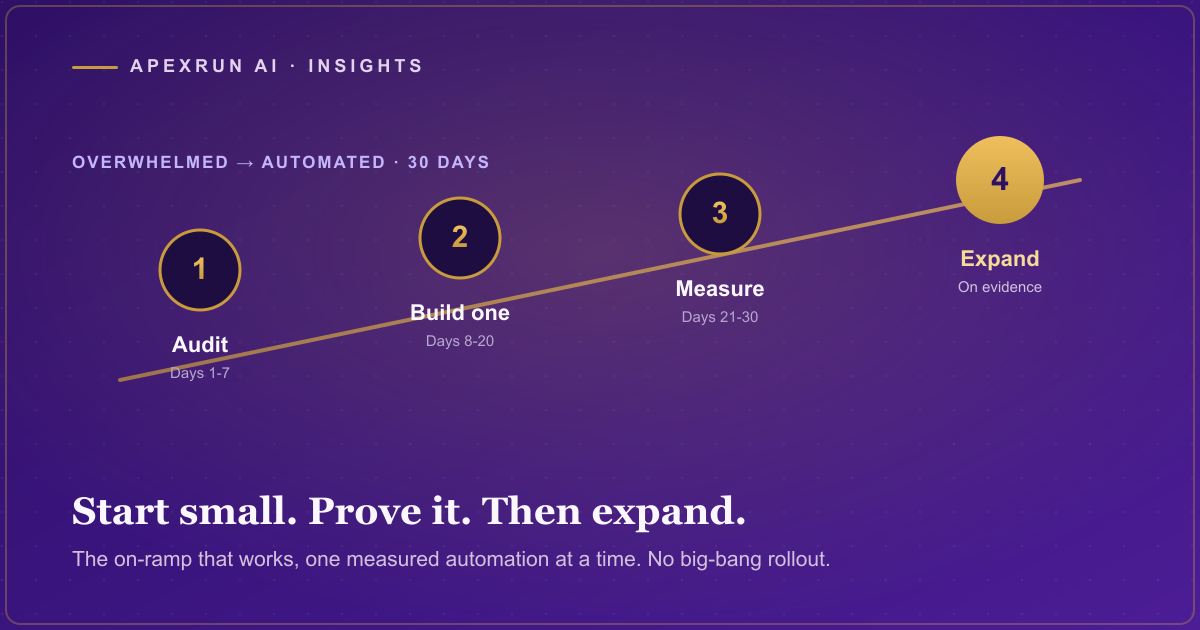
You do not fix this by buying more tools and hoping they add up. You fix it by mapping your operation, finding the highest-value hours the $20 pile is eating, and automating those first, in the order that pays back fastest.
That mapping is exactly what the Free CEO Audit is for. In one hour, direct with the decision-maker, we walk through where your time actually goes, identify the admin an AI operating system can take off your plate, and hand you a prioritized plan, so you know what to build first before you spend a dollar building it. If nothing else, you will leave knowing precisely how much that $20 pile is costing you.
Your seat is worth $400 an hour. Stop spending it on $20 work.