There is a trap built into the way most AI is sold, and it only springs once the thing is working well enough to matter. The local AI vs cloud AI cost question looks like a boring procurement detail at the start, when you are running a few tasks and the bill is trivial. It stops being boring the moment the system becomes genuinely useful, because cloud AI is priced per token, which means the more work it does for you, the more you pay, and there is no ceiling. Success is the thing that makes the bill climb. That is a perverse arrangement, and most owners do not see it until they are already on the wrong side of the curve.
I want to lay out the actual economics, because the sticker price at signup tells you almost nothing about what this costs at the scale where it earns its keep.
The local AI vs cloud AI cost curve, plainly
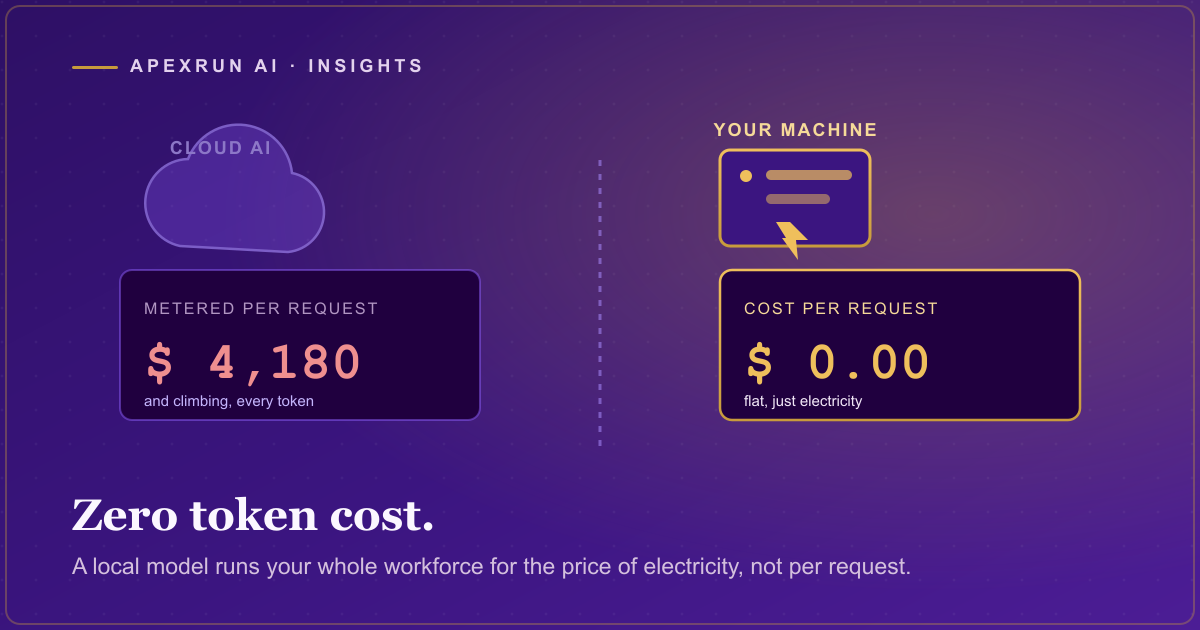
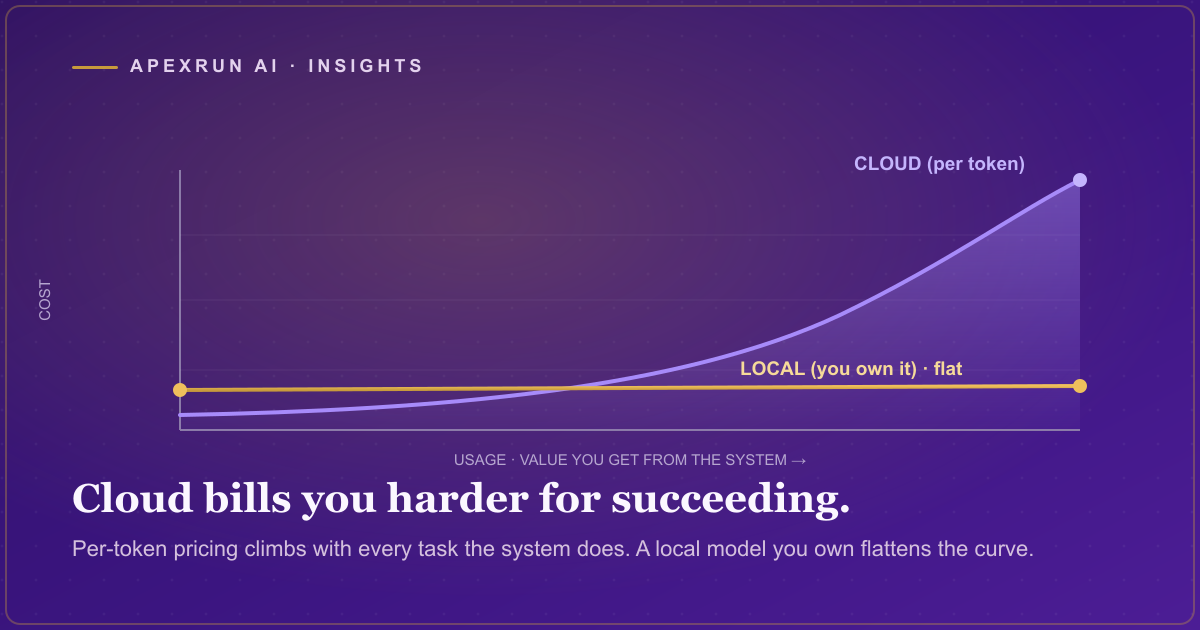
Cloud AI charges you by usage. Every request, every document processed, every message drafted, every summary generated runs up a meter. When you are dabbling, the meter barely moves. But the whole point of a real system is that it runs constantly, carrying recurring work across your entire operation, and a system that runs constantly is a meter that runs constantly. The better it works, the more you use it. The more you use it, the more you pay. Your cost curve rises in lockstep with the value you are getting, which sounds fair until you notice what it means: you are penalized precisely for succeeding.
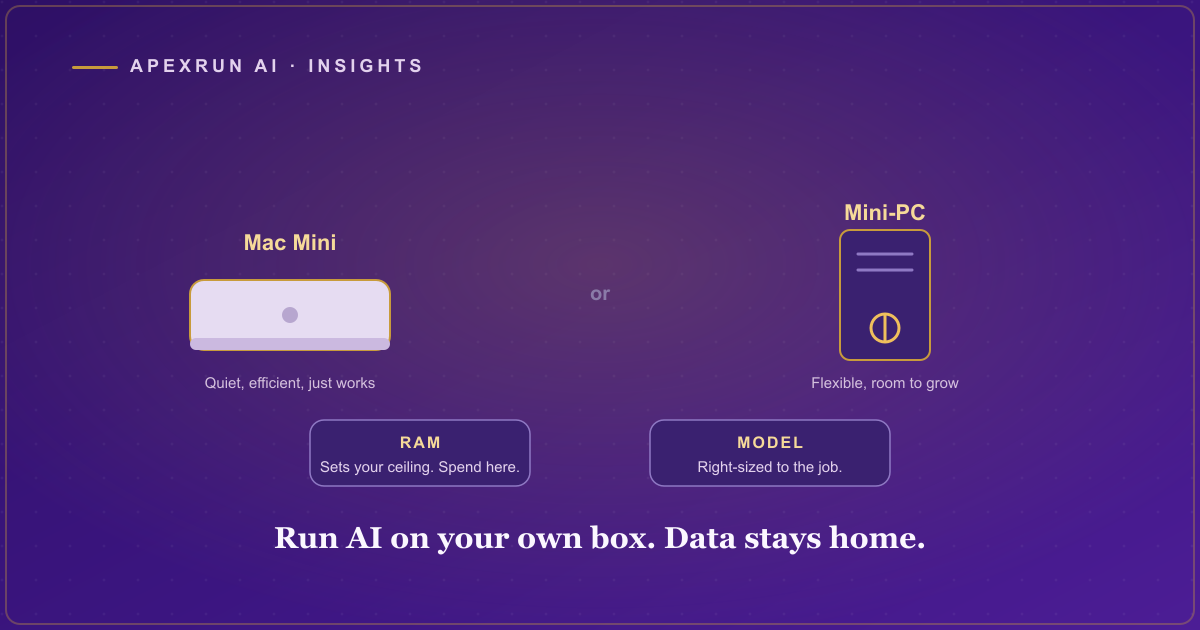
A local model inverts that. You run the model on hardware you own, in your own office, and the cost is essentially the box and the electricity. Whether the system processes ten tasks a day or ten thousand, the hardware cost does not move. There is no per-token meter, because you are not renting someone else’s inference by the request. Your cost is roughly flat, and it does not care how much value you extract from it. This is the zero-token-cost reality: once you own the model, using it more is free at the margin, which is the exact opposite of the cloud arrangement.
Put the two curves side by side. Cloud starts cheap and climbs forever with your usage. Local starts with a hardware cost and then stays flat no matter how hard you run it. There is a crossover point, and past it, every additional bit of value you get from the system is money the cloud takes and the local model does not.
Why this bites exactly when the system is working
Here is the part that makes the cloud model quietly dangerous rather than merely expensive. The cost hits hardest at success, not at failure.
If your AI barely gets used, the cloud bill stays small, and you never feel the problem. But a lightly used system is a system that is not doing much for you, which is its own failure. The scenario you actually want, the one where the system is running your admin across the whole business and giving you real hours back, is the exact scenario where per-token pricing turns into a serious recurring cost. So the cloud model punishes the outcome you are paying to achieve. You succeed at deploying AI, and your reward is a bill that grows with every task it takes off your plate.
That is backwards, and it shapes behaviour in a bad way. Owners on per-token pricing start rationing usage to control the bill, holding the system back from doing work it could easily do, which defeats the purpose. You bought a workforce and then found yourself telling it to do less so the meter would slow down. A fixed-cost local model removes that pressure entirely, because there is no meter to watch. You let it run as hard as the work demands, and the cost does not flinch.
The ownership difference underneath the math
The cost curve is a symptom of a deeper difference: renting versus owning. Cloud AI is a rental. You are paying, forever, for access to a model that lives on someone else’s servers, and the meter is the rent. Stop paying and you have nothing. A local model is an asset. You bought the hardware, the model runs on it, and the capability is yours whether or not you keep sending anyone a monthly cheque.
That ownership is why the economics flatten, and it comes with two things the cost curve does not even capture. Your data stays in your building instead of being shipped to a provider to be processed, which matters enormously in any field handling sensitive information. And your capability does not depend on a vendor’s pricing decisions, availability, or willingness to keep serving you at a rate you can afford. You are not exposed to a price hike on a service you have built your operation around. The full shape of that owned-system model is what the packages lay out, and it is the same argument across every profession on the industries page: the businesses that come out ahead are the ones that own the capability rather than renting it by the token.
The honest caveat on when cloud still makes sense
I am not going to pretend cloud is always wrong. For a business that is genuinely just experimenting, running a handful of tasks, and unsure whether it wants a real system at all, cloud’s low entry cost is a reasonable place to start, because you are below the crossover and the hardware would be overkill. The mistake is staying on the cloud curve after the system has become central to how you operate, because that is exactly the point where per-token pricing turns from cheap trial into a tax on your own success that compounds every month you leave it in place.
The way to know which side of the crossover you are on, and what the right build is for your actual usage, is the Free CEO Audit. In one hour, direct with the decision-maker, we look at how much recurring work you would put on a system, where your cost curve bends, and whether an owned local model pays off for your volume, then hand you a prioritized plan, so you build the version that gets cheaper as it works instead of the one that bills you harder for succeeding.