There is a line in every cloud AI bill that nobody reads until it hurts: cost per million tokens. It looks tiny. Fractions of a cent. Then you wire the thing into your actual operation, point it at real volume, and watch the number climb every single day. This is the part of the AI conversation almost nobody wants to have, so let me have it plainly. A local LLM has no token cost. A model running on your own machine runs your whole workforce for the price of electricity, and once you understand that, the cloud pricing model starts to look like renting a car you never stop paying for.
Most owners meet AI through a cloud tool, so they assume the meter is just how AI works. It is not how AI works. It is how AI is sold.
Why cloud AI meters every request, and why that is the problem
Every time your cloud AI reads a document, drafts a reply, or summarizes a call, it counts the words going in and the words coming out, converts them to tokens, and charges you. That is the business model. It is clean, it is fair on paper, and it has one property that quietly wrecks the economics of automation: the cost scales with success.
Think about what you actually want AI to do in your business. You want it drafting every follow-up, reading every intake, reconciling every invoice, summarizing every meeting, researching every question. You want it running constantly, in the background, on high volume, because high volume is exactly where the time savings live. But high volume is also exactly what per-token pricing punishes. The more useful the system becomes, the more it costs to run. You end up rationing the tool to protect the bill, which defeats the entire reason you bought it.
I have watched owners do this without noticing. They cap the AI at the light tasks, keep it off the heavy recurring work, and wonder why the promised time savings never showed up. The pricing model trained them to use it timidly.
What a local model actually costs
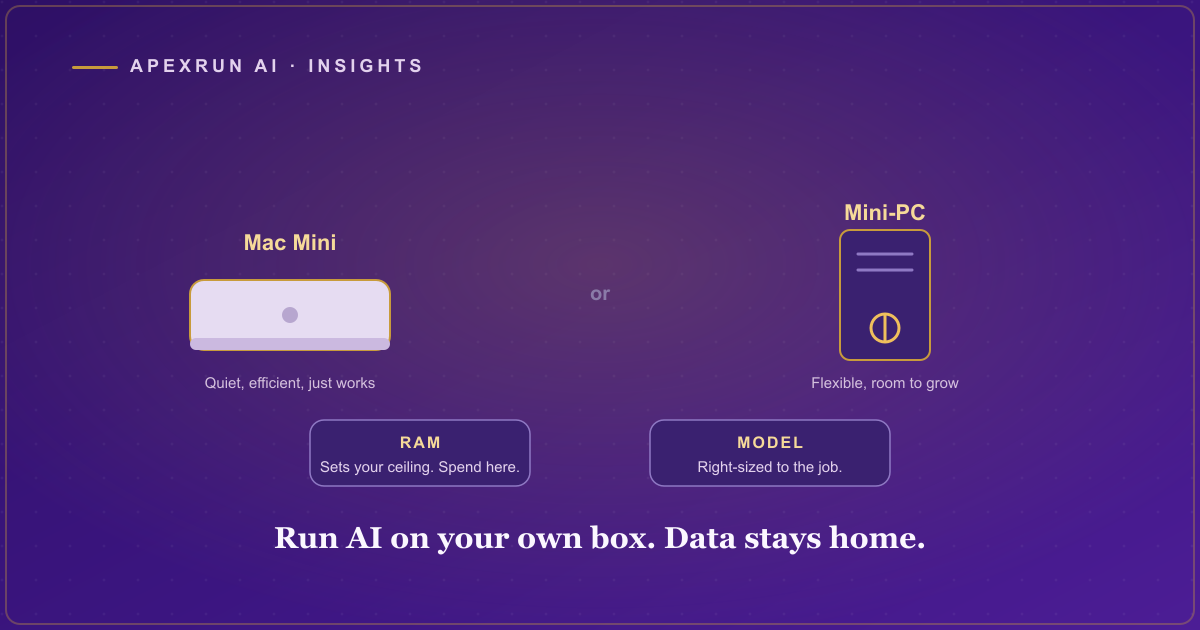
Now flip it. A local model runs on a machine you own, sitting in your office. A capable mini PC or a Mac with enough memory. The model file lives on that machine. When it drafts a document, no request leaves the building, no meter ticks, and no invoice grows. The cost of that draft is a sliver of electricity, and the next ten thousand drafts cost the same sliver.
Here is the honest version of the math, so you can run it yourself.
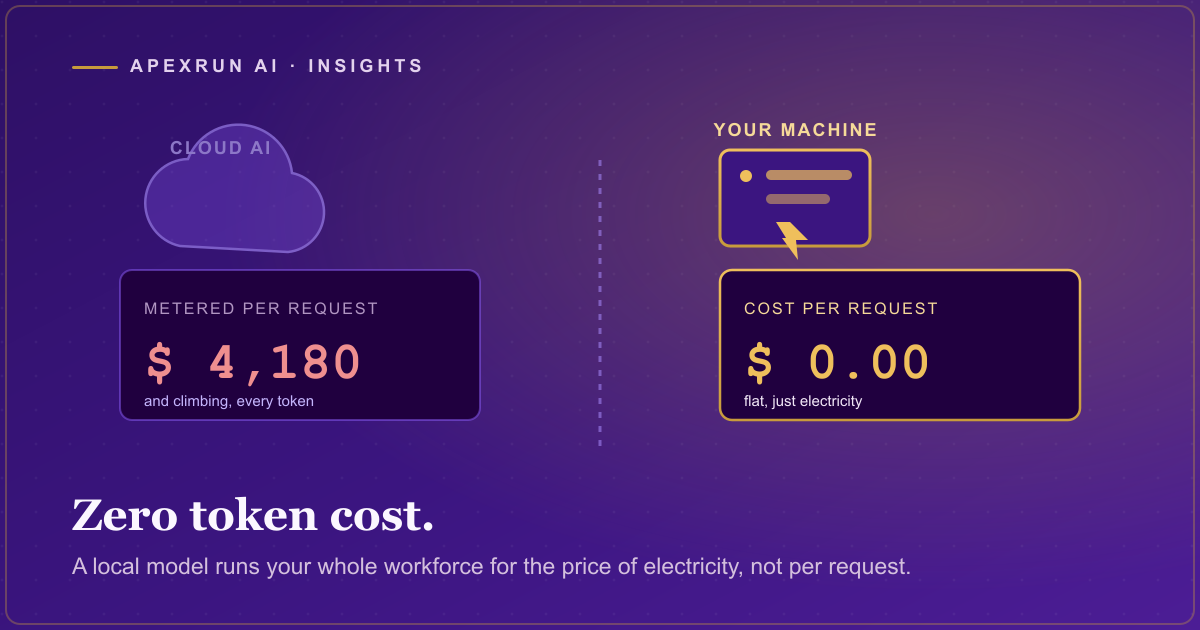
Cloud path: you pay a monthly platform fee, then a variable per-token charge that grows with usage. On a business running AI across real admin volume, the variable side is the part that surprises people. It does not sit still. It follows your growth, and it never ends.
Local path: you pay once for the hardware, roughly the price of a decent laptop [ESTIMATED, hardware varies by workload], and then you pay for the power to keep it on. A machine like this draws less than a couple of light bulbs under load. Whether it runs one task a day or ten thousand, the electricity line barely moves. There is no per-request charge because there is no request leaving your building to charge for.
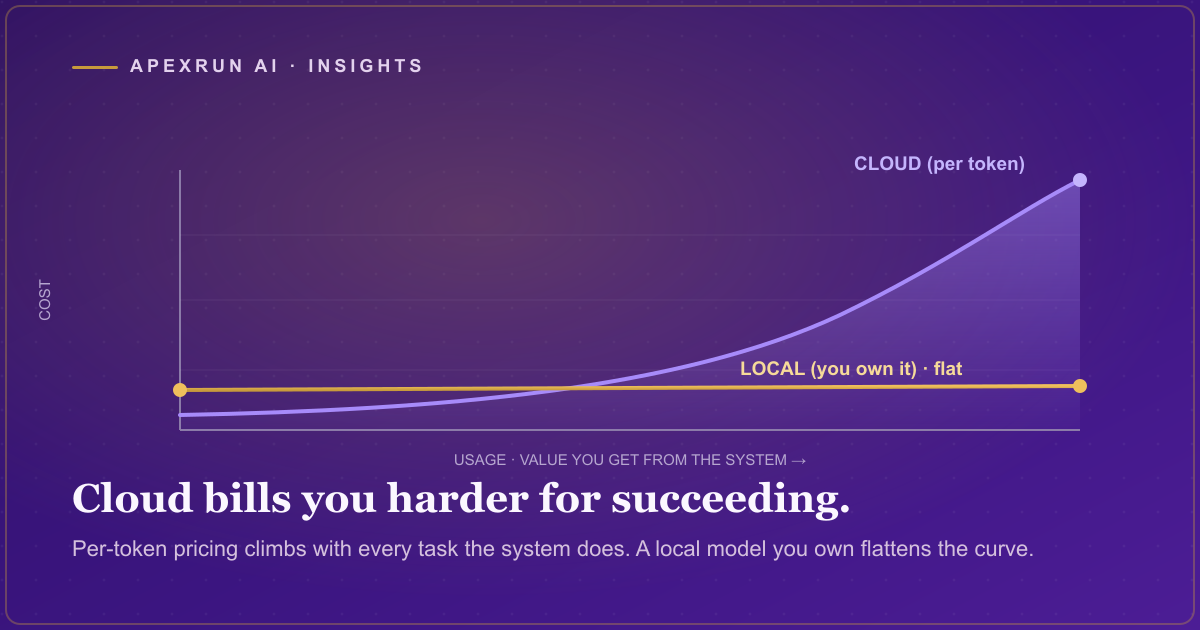
The shape of the two curves is the whole story. The cloud cost curve slopes up forever and steepens the more you use it. The local cost curve is a flat line after the hardware is paid off, usually within months on any serious volume. Past that point, every automation you add is effectively free to run. That is not a discount. It is a different category of expense: a one-time asset instead of a permanent tax.
The behaviour a flat curve changes
The flat curve changes what you are willing to automate. When running the model costs nothing at the margin, you stop rationing. You point it at everything. The low-value 20-dollar admin, the internal reports nobody bills for, the research drafts, the endless follow-ups. There is no reason to hold back, because there is no per-use penalty for turning the volume up.
That is the difference between AI as a cautious experiment and AI as an operating system. A cloud tool you meter is a gadget you use carefully. A local model you own is infrastructure you run flat out. The second one is what actually gives you your week back, because it is running the boring 80 percent constantly instead of only when you can justify the token spend.
The part that is not just about money
There is a second reason the local machine wins for a lot of businesses, and it rides along for free with the cost story. When the model runs on your own hardware, your data never leaves the building. For anyone handling confidential files, client records, medical or legal or financial information, that is not a nice-to-have. It is the difference between AI being usable and being a compliance risk. You get zero token cost and data that stays put, from the same architectural decision. I made the fuller case for keeping sensitive information out of offshore infrastructure in Your Data Should Not Live in a US Data Centre, and it is worth reading alongside this one, because cost and custody are two sides of the same coin.
Where the honest caveats are
I am not going to pretend local is free or effortless, because that is the kind of overclaim that gets businesses burned. The hardware is a real upfront cost. Someone has to set the machine up, install the model, and wire it into your systems, which is work. And the very largest frontier models still live in the cloud, so if your use case genuinely needs the absolute cutting edge on every task, the calculus shifts. For the overwhelming majority of business admin, though, an open model running locally is more than capable, and the recurring economics are not close. You are comparing a one-time purchase against a bill that never stops.
The mistake is treating the sticker price of the hardware as the comparison. The real comparison is one machine you own against years of metered requests that compound with your growth. Run that out over eighteen months on real volume and the cloud path is usually the more expensive one by a wide margin, before you even count the data-residency benefit.
The takeaway
Cloud AI is priced so that using it well costs you more, which is a strange thing to build your operation on. A local model inverts that. Buy the machine once, pay for the electricity, and run your entire admin workforce at a marginal cost of essentially nothing. That is what an AI operating system built on owned hardware gives you that a metered chatbot never will. If you want to see how this plays out for a business like yours, the sector-by-sector breakdown on our industries page is a practical place to start.
The fastest way to find out whether local makes sense for your specific operation is the Free CEO Audit. In one hour, direct with the decision-maker, we map where AI would pay back fastest in your business and whether owned hardware or cloud is the right call for your volume and your data, so you spend on the setup that actually fits instead of the one you were sold.