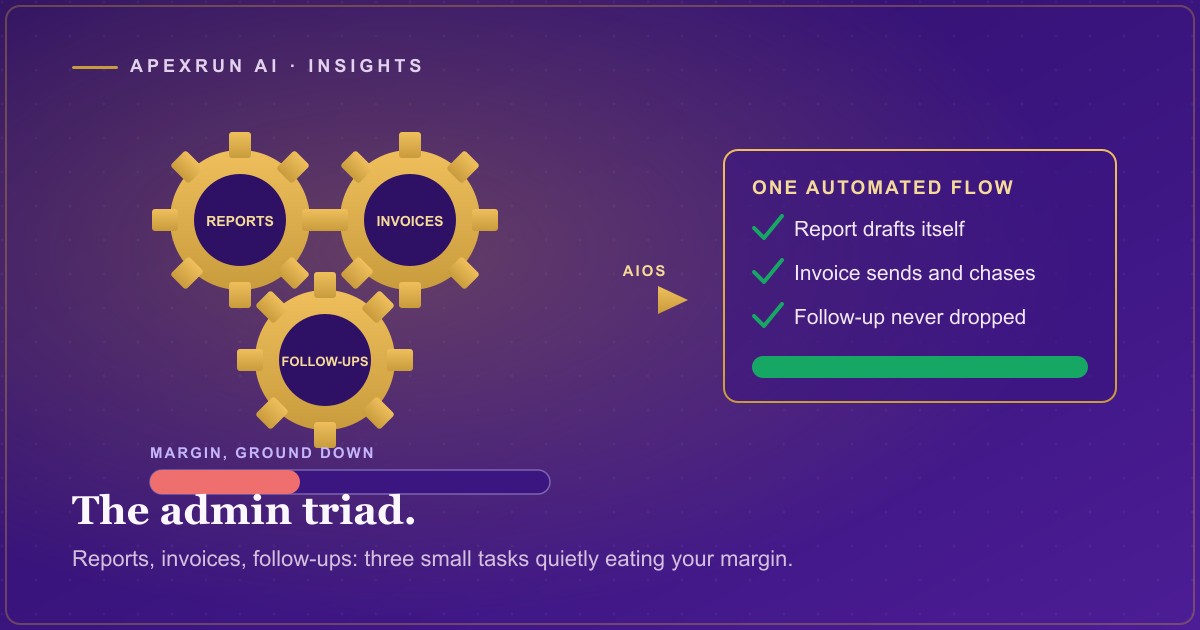
If you want to find where a business is quietly losing money, do not look at the big line items. Look at the small, recurring, unglamorous tasks that nobody owns and everybody does. In almost every business I audit, the same three show up as the biggest silent drains: reports, invoices, and follow-ups. Call it the admin triad. Individually each looks trivial. Together they eat a stunning share of an owner’s week, and the fix is to automate invoices and reports, and the follow-ups that connect them, with a system rather than willpower.
The reason these three do the most damage is that they are recurring, they are boring, and they feel too small to fix. So they never get fixed. They just get done, over and over, by someone whose time is worth far more than the task, forever. That is the definition of a margin leak.
Sink one: reports
Reports are the tax you pay for having information. Month-end summaries, project status updates, management packages, the client-facing recap, the internal dashboard nobody reads but everybody expects. Each one requires pulling numbers from a few places, arranging them, writing the narrative around them, and formatting the whole thing so it looks deliberate.
The insidious part is that reporting produces nothing new. It repackages work you already did. Every hour spent building a report is an hour not spent on the work the report describes. And because reports are recurring, the cost is not one hour, it is one hour times every reporting cycle, forever.
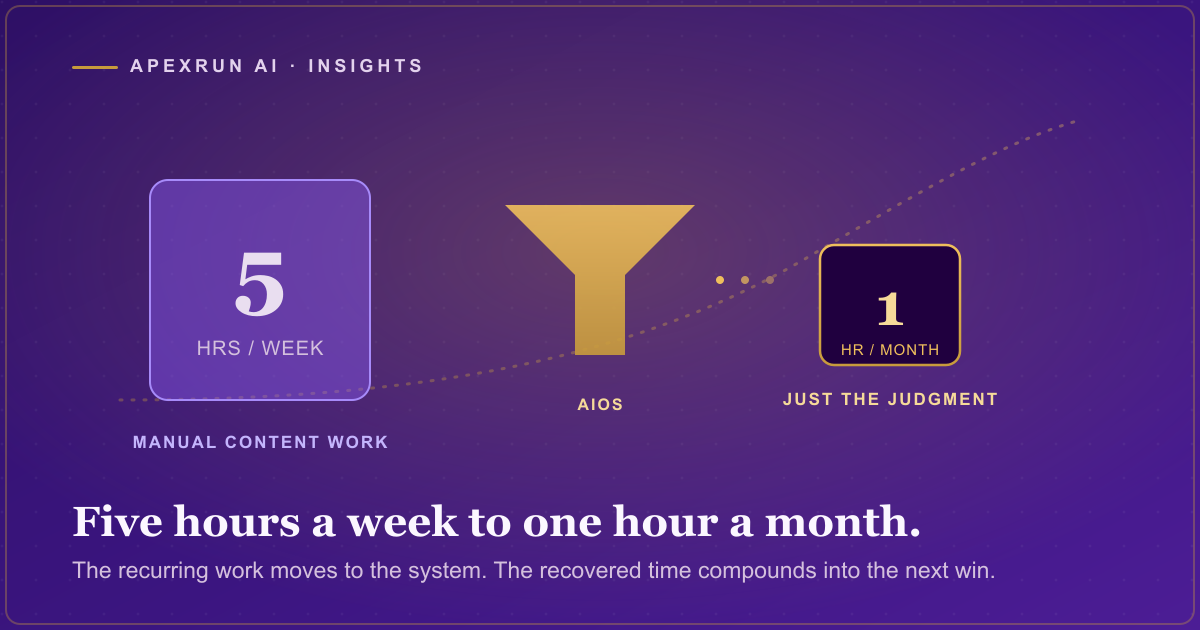
An AI operating system removes most of this. It pulls the numbers from wherever they live, assembles the report, and drafts the narrative from the finished data, so you are editing a strong draft instead of building from a blank page. The recurring ones simply run on their schedule and land in your inbox for a glance and a sign-off. You go from producing reports to approving them, which is a fraction of the time and none of the tedium.
Sink two: invoices
Invoicing is where businesses lose money twice. First on the time it takes to create and send them, and second, worse, on the money that never comes in because the invoice went out late, went out wrong, or the follow-up never happened.
Manual invoicing is a chain of small frictions. Someone has to remember to do it, gather what was delivered or logged, generate the invoice, send it, and then track whether it got paid. Every link is a place it stalls. The invoice that sits unsent for a week is a week of cash you are financing for free. The one with a typo bounces back and restarts the clock. The one nobody chased just sits there, aging.
A system closes every gap in that chain. It generates the invoice from the logged work or the completed job, sends it without anyone remembering to, tracks payment status, and chases the overdue ones on a schedule without you feeling awkward about it. Cash comes in faster because nothing waits on a human to get around to it. This is not just time saved, it is cash flow fixed, and cash flow is the thing that actually kills small businesses. When you automate invoices and reports together, the same finished work that triggers the report also triggers the invoice, with no double handling.
Sink three: follow-ups
Follow-ups are the highest-value work most businesses do worst, because they are the easiest to drop. The lead who asked for a quote and went quiet. The client whose review is due. The proposal sitting unanswered. The estimate that needs one more nudge. Every one of these is money on the table, and every one of them dies in a busy week because following up is nobody’s explicit job and everybody’s afterthought.
The brutal fact is that most of the revenue lost to follow-up is not lost to a “no.” It is lost to silence. The business never followed up, the lead moved on, and no one noticed the gap because a non-event leaves no trace. You cannot see the deals you lost by forgetting.
A system does not forget. It runs the follow-up cadence automatically, in your voice, chasing the quote, nudging the proposal, checking in with the client, and it holds anything that needs your judgment for your approval before it sends. The follow-ups that used to fall through the cracks now happen every time, on schedule, whether or not you had a chaotic week. For most businesses this is the single highest-return automation in the triad, because it does not just save time, it recovers revenue that was silently walking out the door.
Why a system beats fixing them one at a time
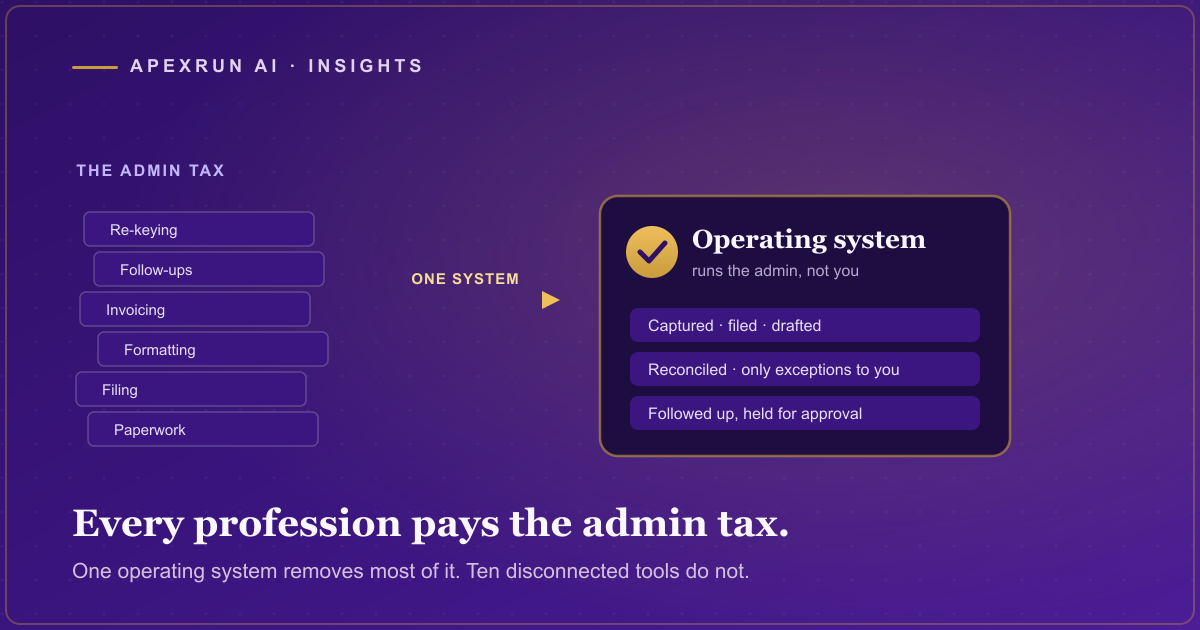
You could try to patch each of these with a separate tool, a reporting app, an invoicing app, a follow-up app. That is better than nothing and worse than it sounds, because the three are connected. The completed work that triggers the report is the same work that triggers the invoice, and the sent invoice is what starts the payment follow-up. Wire them as three disconnected tools and you spend your saved time shuttling data between them.
An operating system treats the triad as one flow, because it is one flow. Work gets completed, the system reports it, invoices it, and follows up on it, as a single connected sequence with your sign-off wherever it matters. That is the difference between a drawer of apps and an operating system, and it is the whole reason the second one compounds while the first one just adds overhead. You can see how the connected pieces fit on our packages page, and the same admin triad shows up in nearly every industry we work with.
The margin was never lost to big things
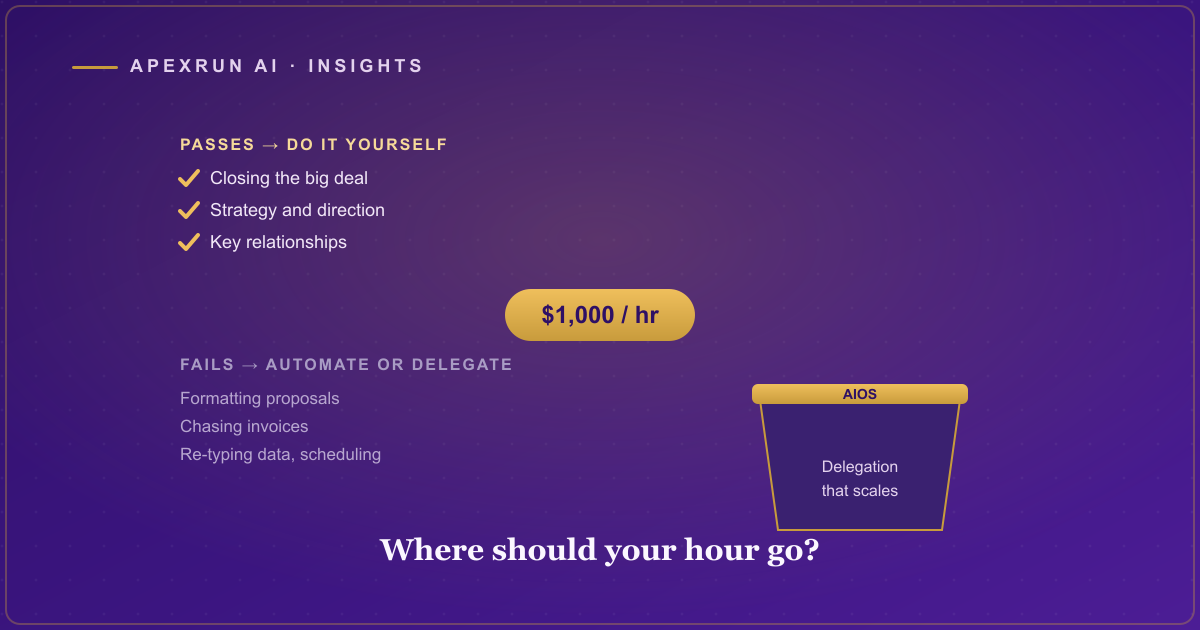
Here is the point to sit with. Owners hunt for margin in pricing, in headcount, in big strategic moves, and miss that a large slice of it is leaking through three small tasks they do every week without thinking. The admin triad does not feel expensive because no single instance is expensive. It is expensive because it never stops. This is the same trap I laid out in stop doing $20 work in a $400 seat: your rate makes routine admin absurdly costly, and it compounds in silence.
You do not fix a recurring leak with a one-time effort. You fix it by putting a system on it so it stops being your job at all.
That is what the Free CEO Audit finds first. In one hour, direct with the decision-maker, we map where your reports, invoices, and follow-ups are actually costing you, and hand you a prioritized plan to automate the triad, so you know exactly which leak to seal first before you spend a dollar. Most owners are genuinely surprised by the number.