Recruiting is a numbers game wrapped around a judgment call, and the numbers half is drowning the judgment half. AI for recruiting agencies starts from a simple observation about how a recruiter’s day actually goes: a huge share of it is spent reading resumes, sending the same screening questions, chasing candidates for availability, booking interviews, and following up with people who went quiet, and almost none of that is the part where a recruiter earns their fee. The fee is in the match, the read on a person, the relationship with the client. The rest is volume work that eats the day and buries the judgment under admin.
That is the specific problem in staffing. It is a high-throughput business where every placement requires wading through a large pile of low-value process to reach the small number of high-value decisions. The recruiter who could be placing people is instead scheduling calls and re-typing candidate details, because the volume of process work does not leave time for anything else. A system that takes the volume off the desk does not replace the recruiter. It gives them their actual job back.
What AI for recruiting agencies actually runs
An AI operating system, an AIOS, is built for exactly this kind of high-volume process work wrapped around human decisions. Four jobs eat a recruiter’s week, and a system can carry the weight of each one.
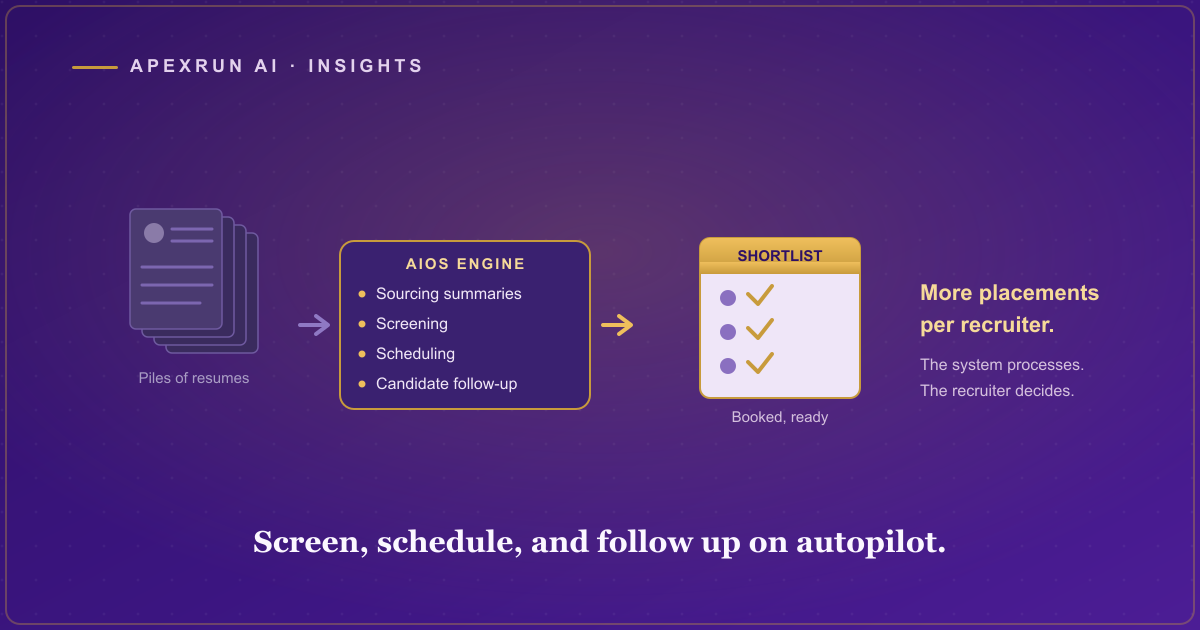
Sourcing summaries. Instead of reading fifty resumes in full to find the five worth a conversation, the recruiter gets a clean summary of each candidate against the role: relevant experience, obvious gaps, the things that matter for this specific job. You read the summary, not the whole pile, and you decide who moves forward from a shortlist the system prepared. The reading work shrinks from hours to minutes, and your judgment goes on the candidates who actually merit it.
Screening. The first-round questions are the same for every candidate for a given role, and a system can run that opening exchange, collect the answers, confirm the basics like availability and salary expectation and location, and flag anyone who does not meet the hard requirements. The recruiter stops spending their day on first-touch screening calls that half the time end in a mismatch on a basic criterion, and instead talks to candidates who have already cleared the bar.
Scheduling. The back-and-forth of finding a time that works for a candidate and a hiring manager is pure coordination overhead, and it is enormous in staffing. A system runs it: offers times, confirms, books the interview, sends the reminders, handles the reschedule. The scheduling tennis that used to eat an afternoon just happens.
Candidate communication and follow-up. This is where placements leak. The candidate who did not hear back and took another offer. The one who went quiet and needed a nudge. The past candidate who would be perfect for the role that just opened but nobody remembered to contact. A system runs the follow-up cadence consistently, keeps candidates warm, and re-engages your existing database, so people stop falling through the gaps between your busy days.
The line: the system processes, the recruiter decides
Here is the part that matters, because recruiting done wrong with AI produces exactly the cold, robotic candidate experience the industry already has a reputation for. The system does not make the hiring decision, and it does not replace the human relationship that is the whole value of a good recruiter. The final read on whether a person is right for a role, the honest conversation with a candidate about their career, the relationship with the client that gets you the exclusive, none of that is the machine’s job, and handing it over would destroy the thing clients actually pay you for.
What the system does is clear the volume so the recruiter has time for the judgment and the relationships. It prepares the shortlist, runs the screening basics, handles the scheduling, and keeps the follow-up alive, and the recruiter spends their hours on the placements and the human conversations that close them. The machine processes, the recruiter decides. That split, preparation by the system and judgment by the person, is the same principle behind every serious use of this technology, which I laid out in what an AI operating system actually is. And because every candidate-facing message can sit behind an approval step, the communication stays professional and human rather than going out on autopilot.
Why this beats just hiring more recruiters or coordinators
The usual fix for a drowning desk is to hire a coordinator to handle the admin, and that helps, but it hits the ceiling every staffing firm knows. A coordinator has hours, gets sick, takes holidays, and can only process so many candidates a day, and when the firm gets busy, the coordinator is the bottleneck. You are back to placements leaking because the process work outran the person doing it.
A system does not have that ceiling. The screening, scheduling, and follow-up run at the same rate whether you are working ten roles or fifty, and the cost does not climb with candidate volume the way another hire would. That frees the coordinators and recruiters you do have to work on the human side, and it means your throughput is no longer capped by how many resumes a person can read in a day. This is the same reclaimed-capacity logic that plays out across professional-services process work, the machine takes the volume so the people do the work that needs a person.
The math on more placements per recruiter
Run it on your own desk. Say screening, scheduling, and follow-up eat half a recruiter’s week [ESTIMATED, varies by firm]. If a system absorbs the bulk of that, the recruiter is not working less, they are spending those reclaimed hours on more candidate conversations and more client relationships, which is the work that produces placements. In a business where the fee per placement is significant, even a modest lift in placements per recruiter per month pays for the entire system many times over. You are not cutting recruiters. You are making each one able to place more people by taking the volume work off their plate. You can see how this maps to a staffing operation specifically on the recruiting command book.
Where to start
Do not try to automate your whole pipeline at once. Start where the leak is worst, which for most staffing firms is either the screening volume swallowing recruiter hours or the follow-up gaps losing placements to whoever answered first.
That is exactly what the Free CEO Audit maps. In one hour, direct with the decision-maker, we walk through where your recruiters’ hours actually go and where placements are slipping, identify the screening, scheduling, and follow-up a system should run, and hand you a prioritized plan, so you know what to turn on first before you spend a dollar. Most firms find their recruiters were spending more than half their week on work that never needed a recruiter.