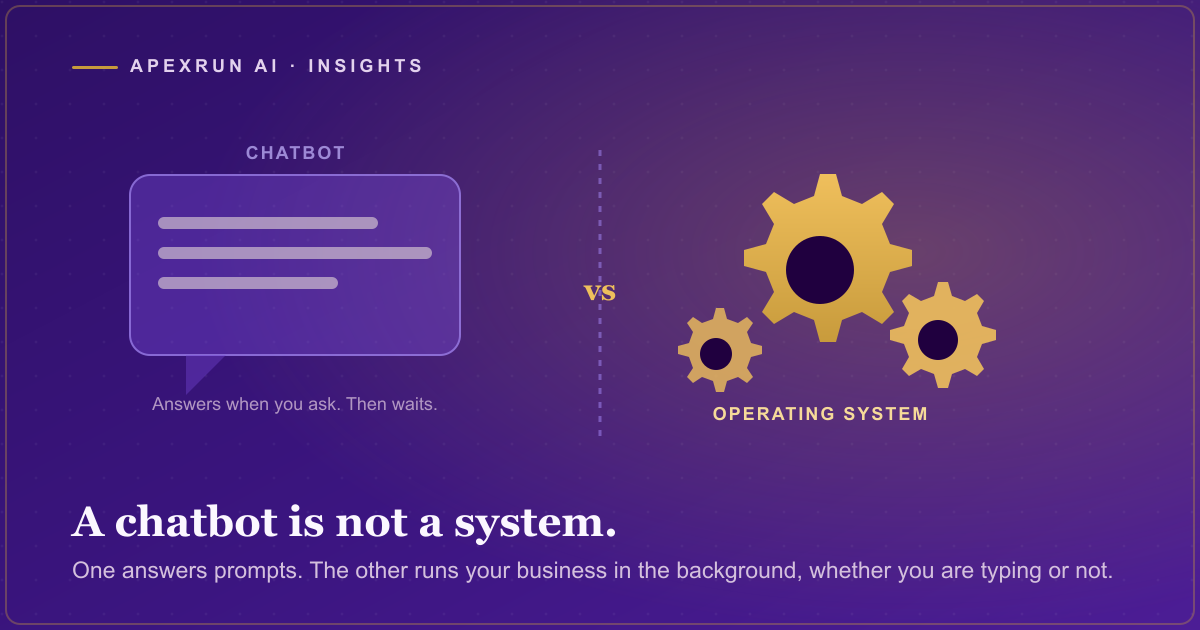
Almost every owner I talk to has already tried ChatGPT, liked it, and quietly concluded they have “done AI.” That conclusion is the most expensive misread in business right now, and it is worth being blunt about. The AIOS vs ChatGPT question for business is not which chatbot is better. It is a category error. A chatbot answers prompts when you ask. An operating system runs your business in the background whether you ask or not. Comparing them is like comparing a calculator to an accountant. Both do arithmetic. Only one of them runs your books while you sleep.
I use ChatGPT. It is a genuinely useful tool. But a tool and a system are different things, and confusing the two is why so many businesses feel busy with AI and see nothing change in their operation.
What a chatbot actually is
Strip it down and a chatbot is a very good answer machine. You bring it a question, a task, a blank page, and it responds well. The intelligence is real. But notice the shape of the interaction: it is entirely on you. You have to be there. You have to know what to ask. You have to open the window, frame the request, take the output, and then do something with it. The moment you close the tab, nothing happens. It has no memory of your business, no awareness of what is going on, and no ability to act. It waits for the next prompt.
That is fine for what it is. It is a phenomenal assistant for the person sitting in front of it. The problem starts when you mistake that for having automated your business, because you have not automated anything. You have given yourself a faster way to do tasks you still have to initiate, one at a time, by hand. The bottleneck is still you. You just type quicker now.
What an operating system does instead
An AI operating system inverts the whole relationship. Instead of you bringing tasks to the AI, the system watches your operation and does the work as it comes up, without waiting to be asked. The lead arrives and it captures the intake, updates the record, and drafts the follow-up. The work closes and it raises the invoice. The week ends and the report is already drafted on your desk. You did not prompt any of it. It ran because it is wired into how your business actually operates, with the context to know what to do and the permission to do the safe parts on its own.
The difference is presence. A chatbot is present only when you summon it. An operating system is present all the time, running in the background, which is the only way you actually get hours back. Time savings do not come from typing prompts faster. They come from work happening that you never had to touch.
The four differences that decide ROI
Put the two side by side on the things that determine whether AI changes your business or just entertains you.
Memory. ChatGPT starts most interactions knowing nothing about your business. You re-explain your context every time, or paste it in again. An operating system is built on a permanent context layer: your clients, your services, your voice, your history. It knows your business the way an employee who has been there for years knows it. That foundation is the difference between generic output and output that belongs in your operation.
Initiative. A chatbot never acts first. It cannot, by design. An operating system does, within the guardrails you set. It follows up, drafts, files, and flags without being told to each time. Initiative is the entire point, because the admin you want gone is precisely the work you keep forgetting to initiate.
Integration. ChatGPT lives in its own window, disconnected from your systems. Whatever it produces, you copy out and carry somewhere yourself, and that carrying is where the promised savings quietly leak away. A draft you have to relocate by hand, update a record for, and then remember to act on is only half automated, and the half left to you is the half that used to get dropped. An operating system is wired into the flow, so its output lands where it needs to be without you couriering it around. That wiring is unglamorous and it is most of the value, because a business does not run on brilliant text sitting in a chat window. It runs on the right thing happening in the right place at the right time, and integration is what makes that happen without you as the courier.
Continuity. Close the chatbot and it forgets you exist. The operating system keeps running. That continuity is what makes it a workforce rather than a tool, and a workforce is what you were actually trying to buy.
Why “just use ChatGPT” quietly caps your business
Here is the trap in the popular advice to “just use ChatGPT.” It is not wrong, it is small. Used well, a chatbot makes you a more efficient operator of a business that still runs on your personal attention. Every task still routes through you. You have raised your own throughput, which is real, and hit the same ceiling, which is you. There are only so many hours you can sit in front of a prompt window.
An operating system raises a different ceiling. It takes the recurring work off your attention entirely, so the business can run wider than one person can personally touch. That is the move from being a faster operator to having an operation that operates without you in every loop. One of those scales. The other one just makes the treadmill quicker.
The honest caveat
I am not telling you to stop using ChatGPT. Keep it. It is excellent for what it is, an on-demand assistant for the person using it, and it composes fine alongside a real system. The mistake is not using the chatbot. The mistake is believing the chatbot is the finish line, closing the laptop, and thinking the job is done while your admin keeps piling up exactly as before. If you want the plain-English version of what the alternative actually is, What Is an AI Operating System lays out the category from the ground up, and the sector breakdowns on our industries page show what it runs in each profession.
The fastest way to see the gap in your own business is the Free CEO Audit. In one hour, direct with the decision-maker, we look at where a chatbot is already helping you and where an operating system would take work off your plate entirely, and hand you a prioritized plan, so you invest in the thing that scales instead of the thing that just speeds up the treadmill.