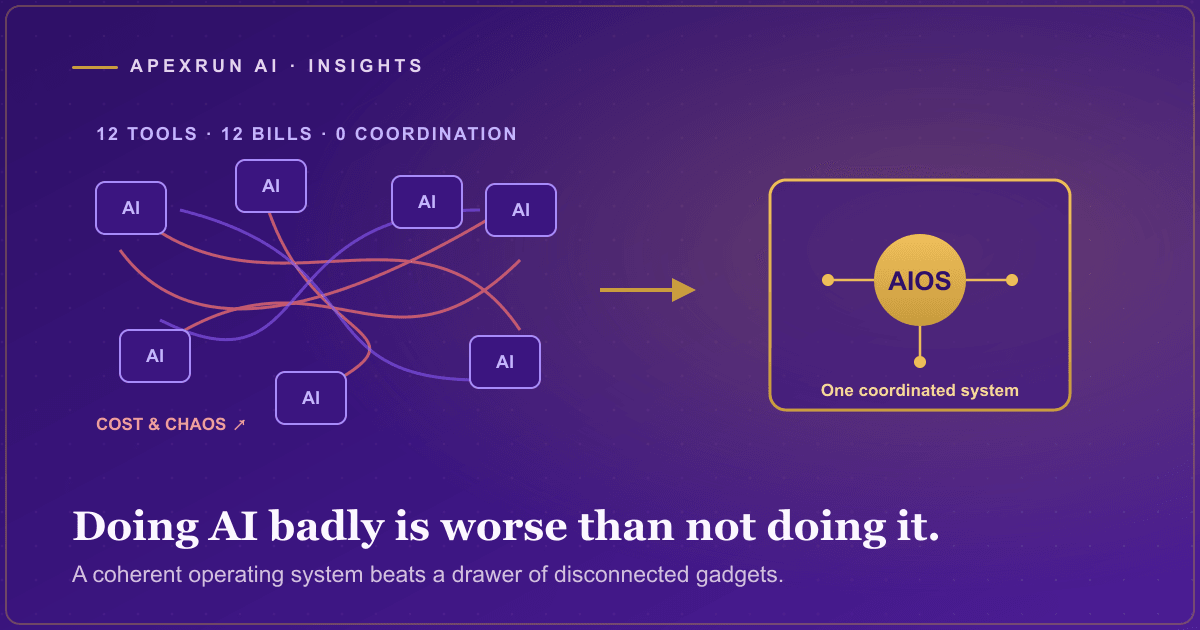
There is a worse outcome than being slow to adopt AI, and almost nobody warns you about it. It is adopting AI badly. The most common and most expensive AI implementation mistake is not waiting too long. It is bolting a dozen disconnected tools onto a business that has no plan tying them together, and then wondering why the promised time savings never showed up. A business that skips AI entirely is standing still. A business that does AI badly is actively spending money and adding chaos to go backwards. That is the trap, and it is worth understanding before you fall into it.
I see it constantly. An owner gets excited, reads that AI is a competitive edge, and starts buying. A note-taker here. A chatbot there. A content tool. A scheduling assistant. Six months and eleven subscriptions later, they are busier than when they started, and they cannot point to a single hour they actually got back.
Worse, the failed rollout does lasting damage beyond the wasted money. The team concludes that AI does not work, because the version they were handed genuinely did not. The owner gets burned and turns cautious right when a coherent build would have paid off. And a competitor who did it properly is now pulling ahead while your business is gun-shy from the mess. A botched implementation does not just cost you the subscriptions. It costs you the confidence to try again and the time you spend cleaning it up.
Why a pile of tools makes things worse, not better
The point-solution trap has a specific mechanism, and once you see it you cannot unsee it. Each tool is designed to solve one narrow task. None of them know the others exist. So the moment you introduce a tool, you also introduce the work of connecting its output to everything around it, and that connecting work lands on a human. You.
The note-taker produces a transcript, but the transcript does not become a follow-up. So you read it and make the tasks. The chatbot captures a lead, but the lead does not reach your pipeline. So you copy it over. The content tool drafts a post, but nothing schedules or files it. So you do that too. Each tool shaves a few minutes off its one task and hands you a new coordination job in return. Stack a dozen of them and you have not automated your business. You have given yourself a second job as the integration layer holding eleven disconnected products together with copy and paste.
Now add the costs that do not show up in the demo. Eleven monthly subscriptions that quietly total real money. Eleven logins, eleven interfaces, eleven things to keep updated and secure. Your team, unsure which tool to use for what, uses them inconsistently or not at all. Sensitive data scattered across nearly a dozen third-party services, each one its own privacy question. The mental overhead of remembering how the whole improvised contraption fits together, which lives in exactly one place: your head. This is not a system. It is sprawl, and sprawl has a cost that climbs every month while the benefit stays stuck near zero.
The three mistakes underneath the trap
When you take apart a failed AI rollout, the same three errors show up almost every time.
The first is buying tools before mapping the problem. The tool gets purchased because it is impressive, not because it solves a bottleneck you actually identified. Impressive is not the same as useful, and a solution shopping for a problem rarely finds a good one.
The second is optimizing tasks instead of flows. Real work is not a list of isolated tasks, it is a flow where one thing leads to the next. Automating a single task in the middle of a flow, while leaving the handoffs manual, often just moves the bottleneck a few feet down the line and adds a new seam where things break.
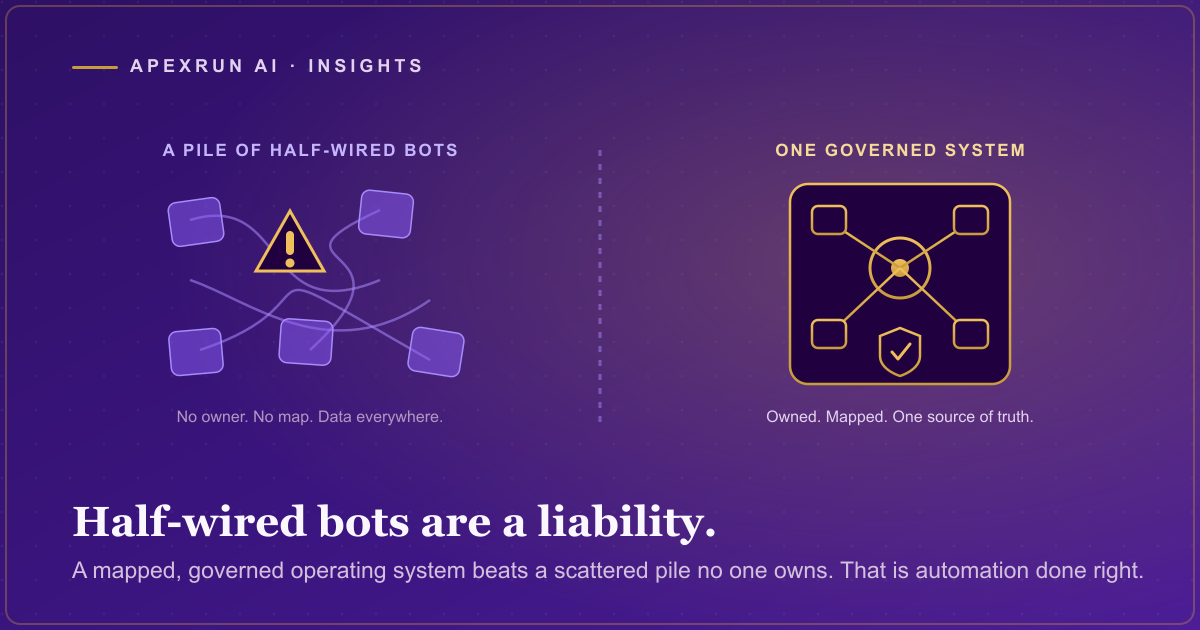
The third is having no owner and no coherence. Nobody is responsible for how the pieces fit, so they do not fit. Each tool was a local decision that made sense on its own, and the sum is a mess that made sense to no one. Coherence does not happen by accident. It has to be designed in from the start, by someone whose job is the whole picture rather than any single tool inside it.
A coherent operating system is the opposite of a drawer of gadgets
The fix is not more tools, and it is not better tools. It is a different structure entirely.
An AI operating system is built the other way around. You start from the flows of your business, not from a catalogue of products. You map how work actually moves: enquiry to intake to delivery to follow-up. Then you automate the whole flow as one connected thing, so the output of each step becomes the input of the next automatically, with your approval where a mistake would matter. There is one system, one place, one coherent logic. Nobody is stitching outputs together by hand, because the stitching is the point of the system rather than an afterthought left to a human.
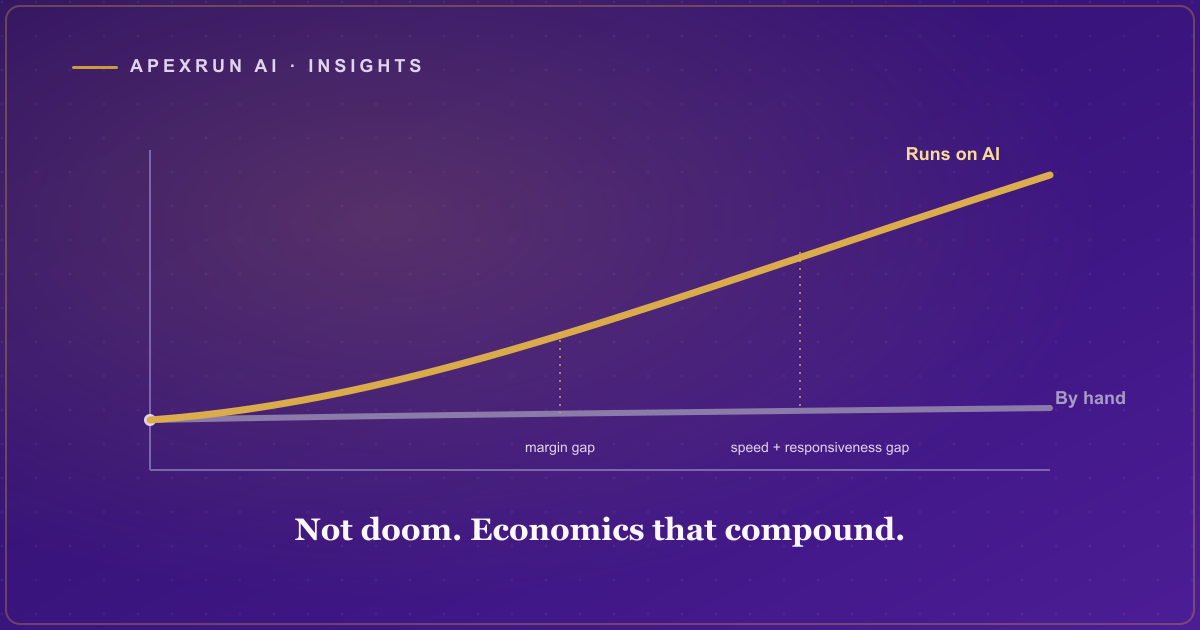
The difference in outcome is not marginal. The drawer of gadgets adds cost and chaos and gives back almost nothing. The operating system gives back real hours because it removes the coordination work, not just individual tasks. One of these compounds in your favour, an argument laid out in The Two-Year Gap. The other one compounds against you, a rising bill for a growing mess.
How to not fall into the trap
The way to avoid the point-solution trap is almost embarrassingly simple: map before you buy. Understand your operation as a set of flows, find the one or two flows where automation pays back fastest, and build those coherently, before you spend a dollar on any tool. Sequence and structure first. Purchases second, if at all. If you want to see how this looks in your line of work, the industries breakdown walks through it by sector.
That mapping is exactly what the Free CEO Audit delivers. In one hour, direct with the decision-maker, we map your flows, identify where a coherent system would take the most work off your plate, and hand you a prioritized plan, so you build a machine on purpose instead of accumulating a drawer of gadgets by accident. Doing AI well starts with the map. Doing it badly starts with the shopping cart, and the difference between those two starting points is the difference between hours reclaimed and money burned.