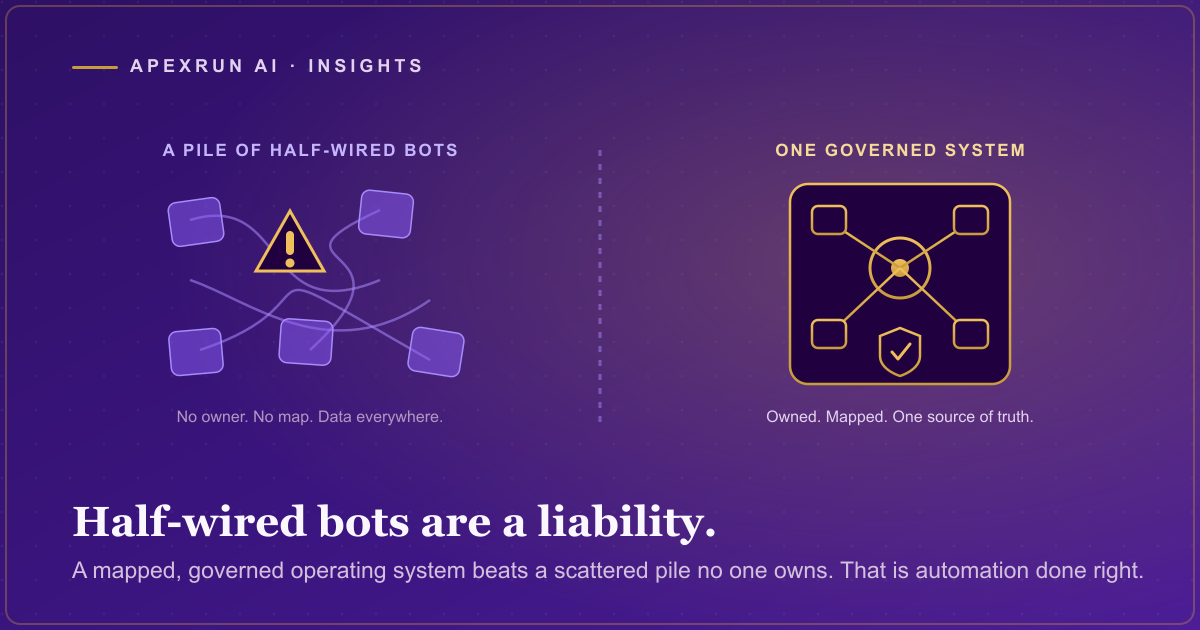
There is a version of adopting AI that leaves you worse off than doing nothing, and a lot of businesses are quietly walking into it right now. They wire up a bot here, a plugin there, an automation someone built in an afternoon, and end up with a sprawl of disconnected tools that nobody fully owns, nobody governs, and nobody can explain. AI automation done right is the opposite of that. It is coherent, governed, and mapped to how the business actually runs. The sprawl is not a smaller version of the real thing. It is a liability, and it can cost you more than the problem you were trying to solve.
I want to be blunt about this because the hype pushes the other way. The pressure is to move fast, plug in whatever is trending, and show that you are “doing AI.” But speed into a mess is not progress. A half-wired collection of automations that sends the wrong email, leaks a client’s details, or contradicts itself across tools does real damage: to your data, to your reputation, and to the trust of the people you serve. That damage is expensive, and it is avoidable.
What AI automation done right actually looks like
The difference between a system and a mess comes down to three things, and none of them are glamorous. They are the exact things people skip when they are rushing.
The first is governance. In a real deployment, every automation has an owner, a boundary, and a rule about what it is allowed to do on its own versus what needs a human to approve. Nothing acts without a defined leash. In the mess, bots act on their own with no oversight, and the first time you find out one has been doing the wrong thing is when a client tells you. The human-in-the-loop principle is not a nice-to-have you add later. It is the load-bearing wall that keeps a system from becoming a liability, and it has to be designed in from the start.
The second is data hygiene. A system built right has one clean, controlled source of truth about your business, and the automations read from and write to it in a disciplined way. In the mess, every tool has its own half-copy of your data, the copies drift out of sync, and sensitive information ends up scattered across a dozen services you do not control and could not list if asked. That scatter is where the leaks come from, and in a regulated business it is where the fines and the lost clients come from too.
The third is coherence. In a real system, the pieces know about each other and work toward the same outcome. In the mess, you have a bot that books the appointment, a different tool that sends the reminder, and a third that handles the follow-up, and none of them share context, so the client gets contradictory messages and a disjointed experience that looks worse than no automation at all. Coherence is what makes a set of automations feel like one competent operation rather than a committee of strangers.
Why a pile of bots is worse than one mapped system
The seductive thing about the pile is that each individual piece looks cheap and easy. One automation to handle intake. One to chase invoices. One to post to social. Each one, on its own, seems like a small win. The problem is what happens when you have twenty of them and no map.
Nobody can see the whole picture. When something breaks, you do not know which tool did it or why. When a client asks what happened to their data, you cannot answer, because it lives in six places. When you want to change how you work, you have to untangle a web that grew without a plan. The maintenance cost climbs quietly until the sprawl is eating more time than the manual work it replaced, and the risk climbs with it, because every ungoverned tool is a door you left unlocked.
A mapped AI operating system inverts that. Instead of many disconnected tools, it is one coherent layer that sits across your business with a single source of context, defined guardrails, and an owner for every action. It is more work to set up correctly, and that is exactly the point: the discipline you invest at the start is what stops the liability from accumulating later. I have written about the specific ways rushed AI backfires in the cost of doing AI badly, and almost every failure traces back to the same root, which is a pile that was never mapped.
How to avoid the expensive mess
Avoiding the mess is not about moving slower for its own sake. It is about doing three things before you wire anything up.
Map before you build. Know where your data lives, which processes actually need automating, and what the flow looks like end to end, before you connect a single tool. A map turns a scattered pile into a designed system, and it is the single cheapest insurance you can buy against the expensive version of this.
Govern from day one. Decide up front what any automation is allowed to do without a human, put every client-facing action behind an approval step until you have earned the right to loosen it, and give every piece an owner. Governance added after a leak is damage control. Governance designed in is prevention.
Keep one source of truth. Resist the urge to let every tool keep its own copy of your data. A single controlled context layer that the automations share is what keeps your information governed, your outputs consistent, and your business explainable when someone asks how it works. You can see how this maps profession by profession on the industries page, where the same discipline applies whether the risk is a client’s health record or a signed contract.
The honest bottom line
AI can absolutely take work off your plate and give you leverage you did not have before. But the version that does that is the mapped, governed, coherent one, not the pile of half-wired bots that looks busy and quietly turns into a liability. Doing this fast and badly is not a shortcut. It is a longer, more expensive road with a data breach or a lost client somewhere along it.
The way to get the leverage without the liability is to start with the map, not the tools. That is what the Free CEO Audit gives you. In one hour, direct with the decision-maker, we look at your actual processes and data, identify where automation is safe and high-value versus where it would create risk, and hand you a prioritized, governed plan, so you build one coherent system instead of a mess you will spend next year untangling.