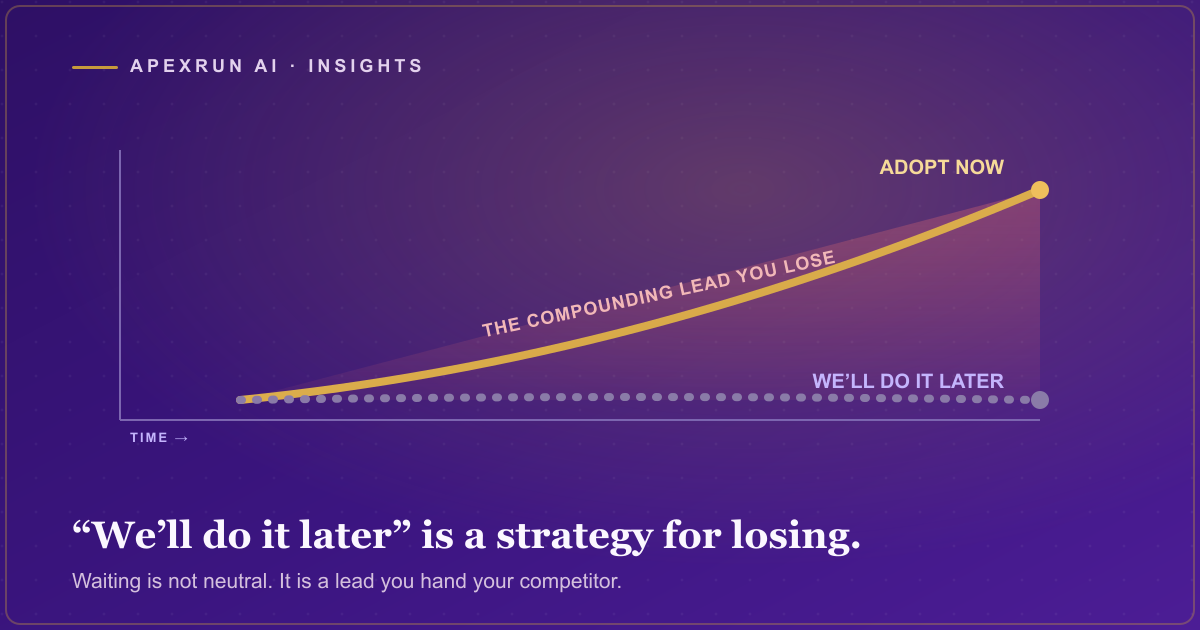
“We’ll do it later” feels responsible. It sounds like prudence. You are not rushing, you are not chasing hype, you are waiting for the technology to settle and the case to be obvious before you commit. The problem is that in a compounding game, later is not a neutral choice. It is a decision to fall behind, and the reason to adopt AI now is not fear of missing a trend. It is that the cost of waiting is not zero, it is the lead a competitor builds every week you deliberate, and that lead compounds until it is uncatchable.
I am not going to tell you the sky is falling. I am going to walk through why “later” quietly costs more than it looks like it does, and why the businesses that understand this are already pulling away from the ones that do not.
Waiting has a price, you just cannot see it
The trap in delay is that inaction leaves no receipt. When you buy the wrong tool, you feel the cost. When you make a bad hire, you feel it. But when you do nothing, nothing visible happens, so it registers as free. It is not free. You are paying in the deals you did not close because your follow-up was slow, the hours your team spent on admin a system could have run, the margin you left on the table while a competitor took the same revenue at a lower cost to serve.
None of that shows up on an invoice, so it never triggers a decision. That is exactly why it is dangerous. The most expensive costs a business carries are the ones that never send a bill, and “we’ll do it later” is one of the biggest.
Efficiency compounds, which is why the gap widens
Here is the mechanic that makes delay so costly, and it is not intuitive.
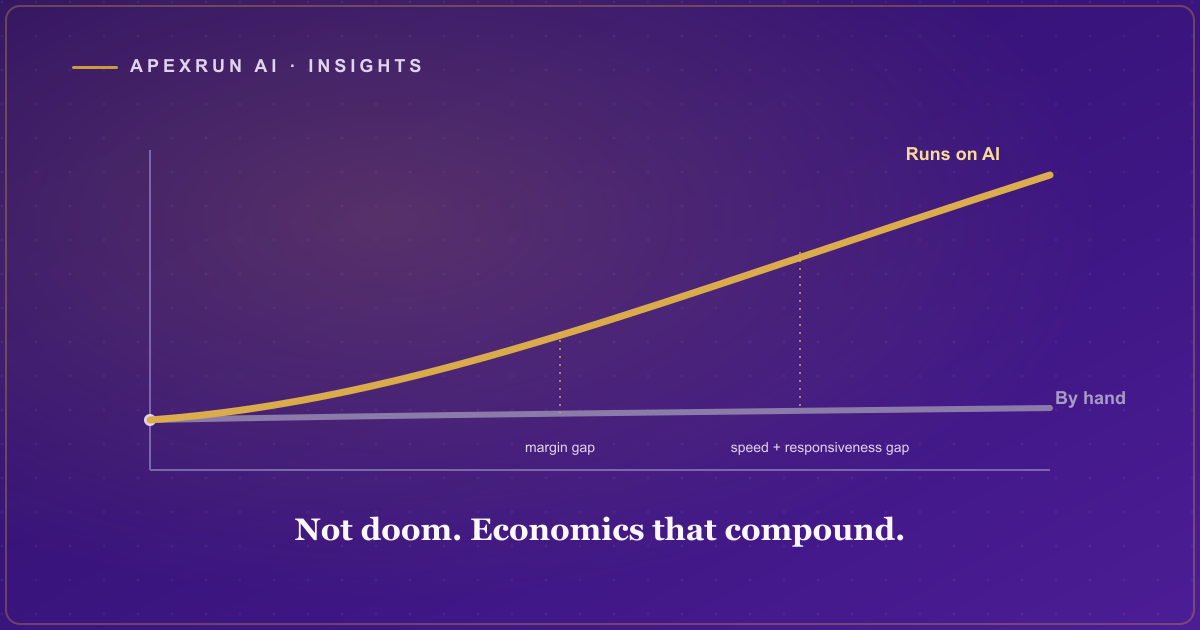
When a competitor automates their admin, they do not just save a few hours once. They redeploy those hours into work that grows the business: selling, serving, building. That growth generates more capacity to automate the next thing, which frees more hours, which funds more growth. Each turn of the loop makes the next turn bigger. It is a flywheel, and I laid out the full mechanic in the efficiency flywheel.
The consequence is that the gap between the business that started and the business that waited does not stay constant. It widens. Every month you wait, the competitor is not just ahead, they are accelerating, because their lead is funding more lead. This is why “we’ll catch up later” is a fantasy. You are not trying to close a fixed gap, you are trying to close a growing one, from behind, with less capacity than the business you are chasing. That is a race you do not win by starting late.
”The technology is not ready” is last year’s excuse
The most common justification for waiting is that the tools are not mature enough yet, so it is smarter to let others take the arrows and adopt once it is proven. That was a reasonable position two years ago. It is not anymore.
The capability to run a real operating system on top of your business, drafting your reports, running your follow-ups, handling your intake, generating your invoices, exists and works today. It is being deployed in ordinary businesses right now, not in labs. Waiting for it to be “ready” means waiting for something that already arrived, while your competitor uses it. The maturity argument has quietly flipped: the risk is no longer adopting too early, it is adopting too late, after the advantage has already been claimed by the people who moved.
”We’re too busy right now” is the tell
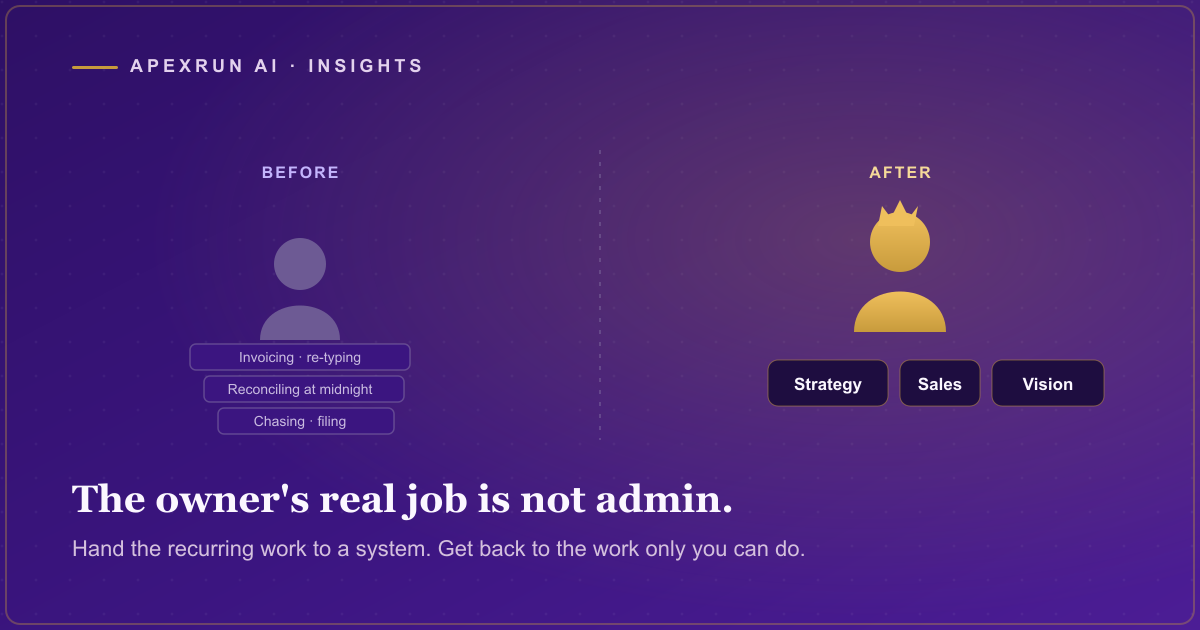
The other excuse is time. We are slammed, we will look at it next quarter when things calm down. Things do not calm down. The reason you are slammed is often the exact problem the system solves: your people, and probably you, are buried in recurring admin that does not need a human. Being too busy to fix the thing that is making you busy is not a scheduling problem, it is a trap, and next quarter you will be just as buried and one quarter further behind.
The businesses that break out of this do not wait for a quiet moment that never comes. They treat the automation of their busywork as the thing that creates the quiet moment. You do not find time to fix the leak, you fix the leak to find the time.
What “now” actually requires (it is smaller than you think)
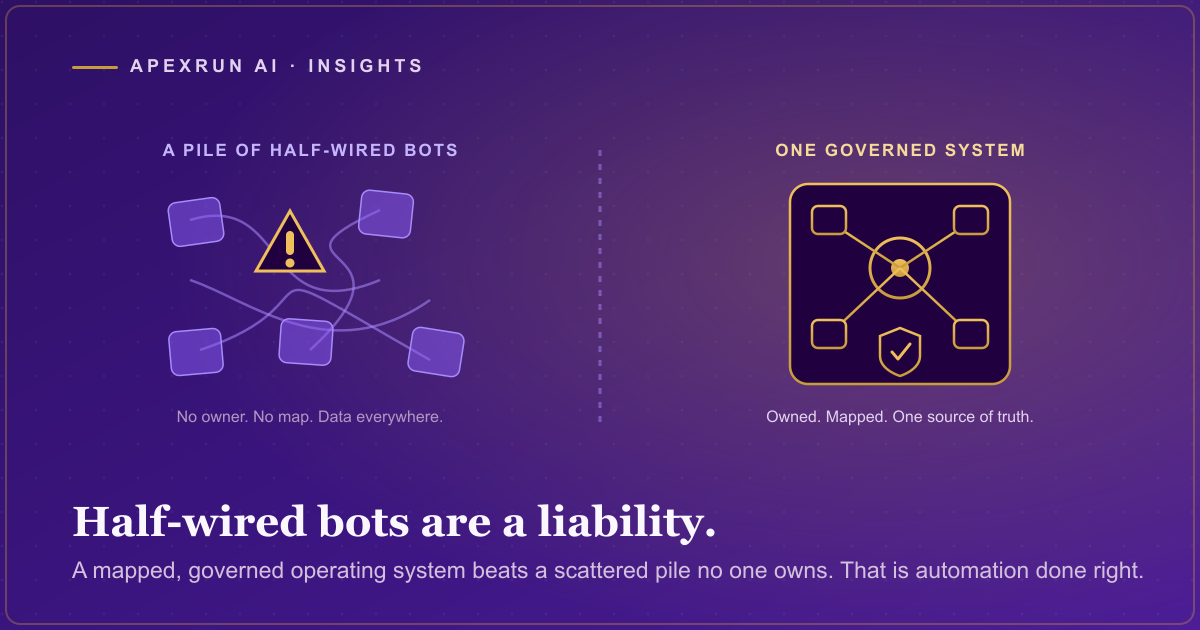
Here is the part that should lower your blood pressure. Adopting AI now does not mean a giant risky overhaul, betting the business on a platform, or rewiring everything at once. That version of “adoption” is a strawman, and it is genuinely a bad idea. Doing AI badly, by bolting on a dozen disconnected tools with no plan, is worse than not doing it at all, which I have argued directly in doing AI badly is worse than not doing it.
The right version of “now” is a mapped, sequenced start. You find the highest-cost, highest-recurrence busywork in your operation, you automate that one thing first, you measure it, and you expand from a win. Small, deliberate, low-risk, and it starts paying back immediately. That is what an operating system looks like when it is deployed properly, and you can see the fuller frame across the industries we work with, where the same handful of admin drains show up over and over.
The point of starting now is not to have finished. It is to be on the compounding curve instead of watching a competitor ride it. The first automation is small. Being twelve months into the flywheel instead of at zero is not small at all.
The honest version of “later”
If you are going to wait, at least be honest about what you are choosing. You are not choosing safety. You are choosing to let a competitor build a lead while you deliberate, on the theory that you can close a widening gap later, from behind, while carrying the same admin load that is slowing you down today. Said plainly, that is not a strategy. It is a decision to lose slowly.
The good news is that the fix is not dramatic and the start is cheap. The Free CEO Audit is one hour, direct with the decision-maker, and it maps exactly where AI would pay back fastest in your specific business, then hands you a prioritized plan so you know the single highest-return thing to build first before you spend a dollar. It is the smallest possible way to stop waiting and get on the curve. Later is not free. Start with the audit.