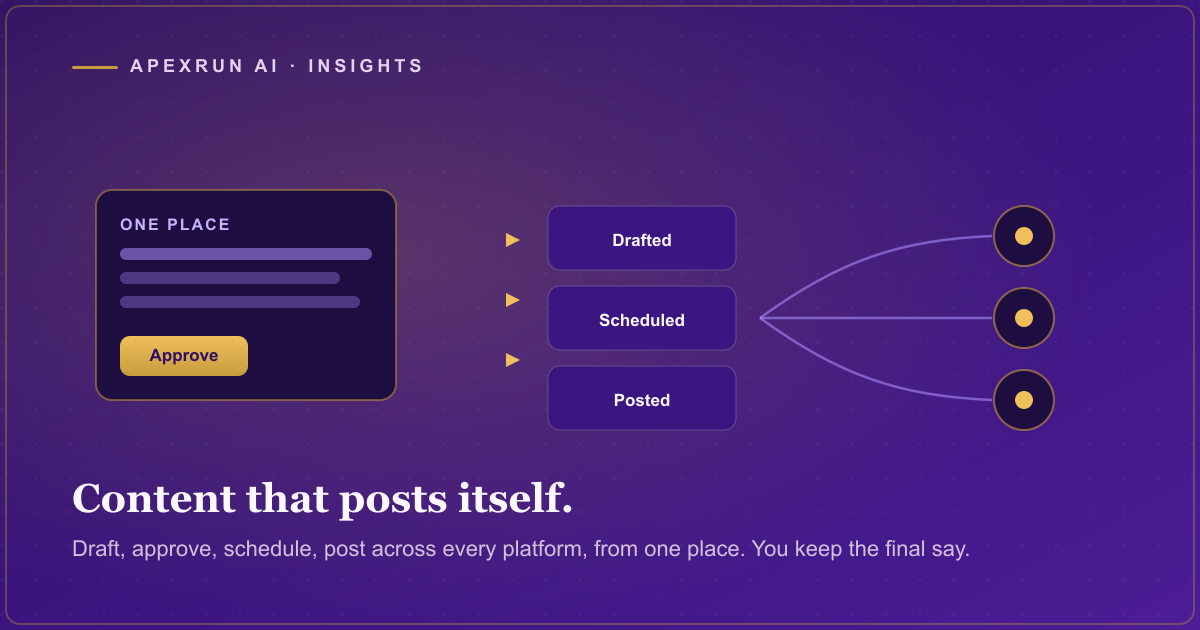
The single biggest fear owners have about automation is not that it will not work. It is that it will work, unsupervised, on the wrong thing, and do damage before anyone notices. They picture a system firing off a wrong email to their whole client list, quoting a price it made up, or telling a customer something that is simply not true, all at machine speed, with nobody watching. That fear is correct and healthy, and human in the loop AI automation is the specific answer to it. Good automation does not act freely on anything that matters. It asks first.
I want to spend this whole piece on that mechanism, because it is the difference between a system you can actually trust and one you would be reckless to turn on. The owners who get burned by AI are almost always the ones who let it act autonomously on things that carried real consequences. The design that avoids that is not complicated, but it has to be deliberate, and most people selling AI do not talk about it because “fully automated” sounds more impressive than “it checks with you first.”
What human-in-the-loop actually means
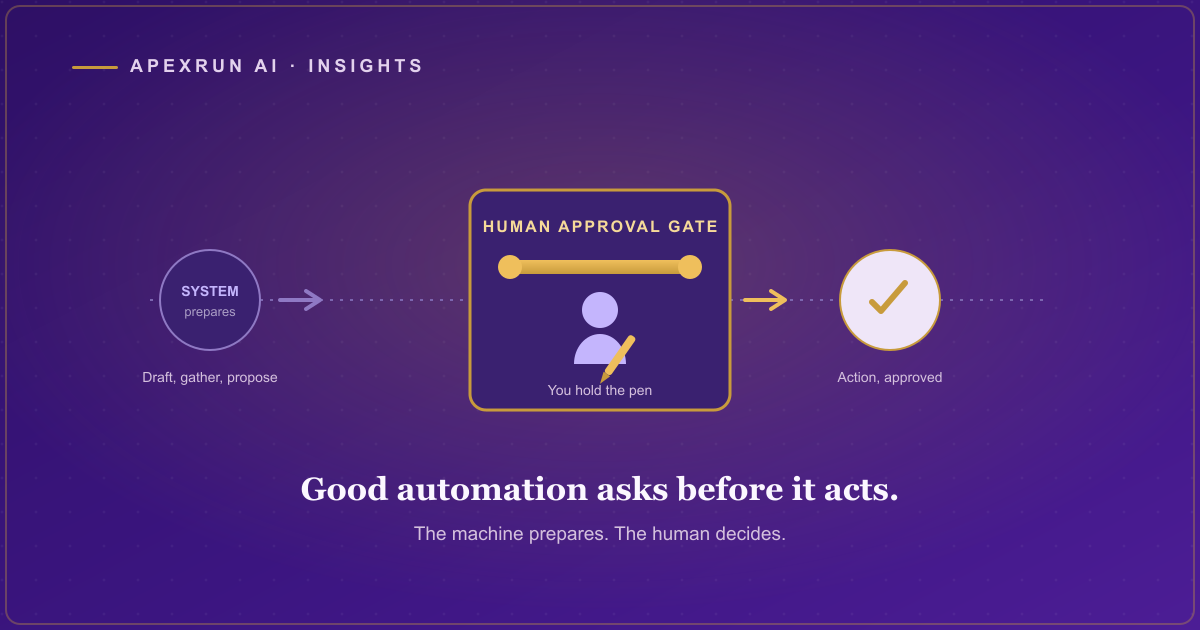
Human in the loop AI automation means the system does the work, but a person stays in the decision path for anything with real consequences. The machine prepares, gathers, drafts, and proposes. The human reviews and approves before the consequential action happens. The loop is the approval step, and keeping a human in it is a deliberate design choice, not a limitation to be engineered away.
The key distinction is between two kinds of tasks, and getting this line right is the entire craft. Some tasks are low-consequence and reversible: matching a clean transaction, filing a document, drafting a first version, flagging something odd for you to look at. If the system gets one of those slightly wrong, you catch it in review and nothing has left the building. Those tasks can run freely, because the cost of an error is a quick correction. Other tasks are high-consequence and hard to undo: sending a message to a client, committing to a price, filing something official, moving money, telling a customer something they will act on. Those never happen without a human approving them first. The system does all the preparation right up to the edge of the consequential action, then stops and waits for you.
The three controls that keep it safe
There are three mechanisms that make this real, and a system without all three is not safe, it is just fast.
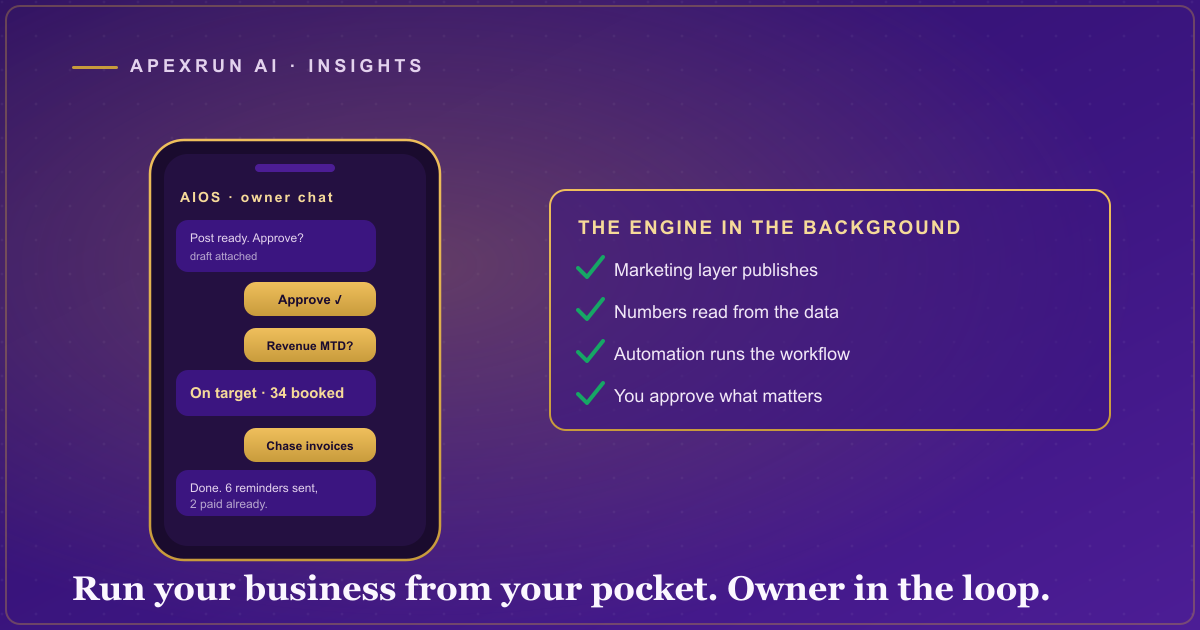
Approval gates. Every action that matters has a checkpoint where a human says yes before it proceeds. The system drafts the client email and holds it for your approval. It prepares the quote and waits for your sign-off. It assembles the report and hands it to you to review before anything goes out. The work is done, sitting ready, but the consequential step does not fire until a person releases it. You are approving, not creating, which is fast, but you are still in control of the moment that counts.
Guardrails. Beyond the approval gates, the system operates inside limits you set. It does not invent prices outside a defined range. It does not contact people it was not told it could. It does not take actions outside its defined scope. Guardrails mean that even the things running automatically are running inside a fence, so the range of what can go wrong is bounded by design rather than by hoping the machine behaves. The system is powerful inside the box and cannot act outside it.
Owner control. You can see what the system is doing, change what it is allowed to do, and switch any part of it off. Nothing runs that you cannot inspect and nothing is beyond your reach to stop. This is not a black box that you feed inputs and pray. It is a system you own and direct, which is exactly the point I made in what an AI operating system actually is, you are running it, not surrendering to it.
Why this is a feature, not a compromise
Here is where people get it backwards. They think the approval gates and the human checks are a weakness, a sign the technology is not ready to be trusted on its own. That is exactly wrong. The approval gates are the reason you can trust the system with real work in the first place.
Fully autonomous AI acting on consequential decisions with no human in the path is not the advanced version. It is the reckless version, and any serious professional would refuse it, correctly. An accountant will not let a machine file returns unreviewed. A lawyer will not let one send client advice unchecked. They are right, and a good system agrees with them by design. The value is not the machine acting alone. The value is the machine doing ninety percent of the work, the preparation, the drafting, the gathering, so that the human ten percent, the judgment and the approval, is all that is left for the person to do. That is the whole architecture, and it stacks on top of the other layers I described in the five layers of an AIOS.
What this looks like across real work
The pattern is identical wherever you apply it. In an accounting firm, the system reconciles and drafts, and the accountant signs the numbers that go out. In a real estate team, the system nurtures leads and drafts listing content, and the agent approves what gets sent and handles the deal. In any business, the system chases the follow-up and prepares the documents, and the owner releases anything that reaches a customer. Every place a mistake would be costly gets a human gate. Everywhere the work is safe and reversible, it just gets done. You can see how this applies across the industries we work with, the line moves depending on the work, but the principle never does.
The result is a system that is genuinely useful and genuinely safe at the same time, which is the only combination worth deploying. Speed on the work that is safe to run, a human hand on everything that matters.
Where to start
If the thing holding you back from automation is the fear of it going rogue, that fear is pointing you at the right question, which is not whether to automate but where the human gates need to sit. The answer is different in every business, and getting it right is the whole job.
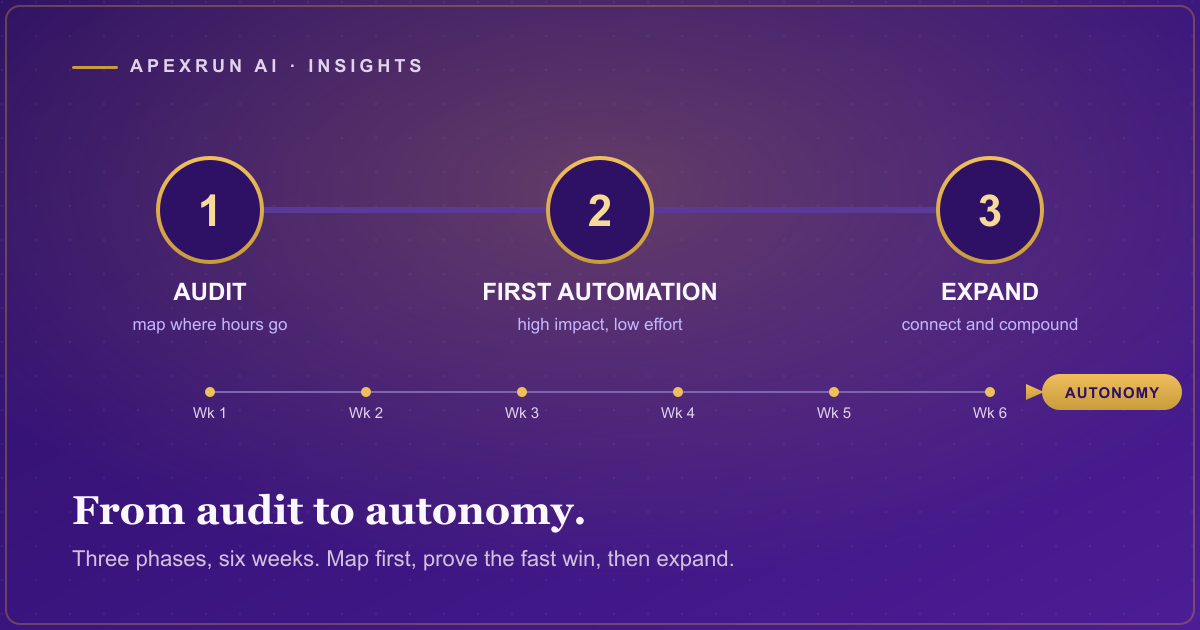
That is what the Free CEO Audit maps. In one hour, direct with the decision-maker, we walk through your actual work, mark clearly which tasks are safe to run and which need a human approval gate, and hand you a prioritized plan built around that line, so you get the automation without ever handing a machine the keys to something that matters, before you spend a dollar building it.