Most people picture an AI system as a dashboard: a screen full of panels you log into, learn, and check. That is not how the good ones actually get used day to day. The interface that wins is the one you already have open, the chat app in your pocket. When you can run your business from your phone with AI through a single chat thread, approving what needs approving, pulling the numbers you want, and kicking off tasks with a message, the system stops being software you visit and becomes an operator you talk to. That is the intelligence layer of an AI operating system, and it is the piece that makes owner-in-the-loop control practical instead of theoretical.
We build this on Telegram, and the choice is deliberate. It is a chat app you already know, it works on any phone, it is secure, and it turns the whole operation into a conversation. No new dashboard to learn, no desktop to be chained to. Just a thread where your business reports to you and takes instructions back.
What “runs your business from your pocket” actually means
Strip away the abstraction. Here is what it looks like in an ordinary day.
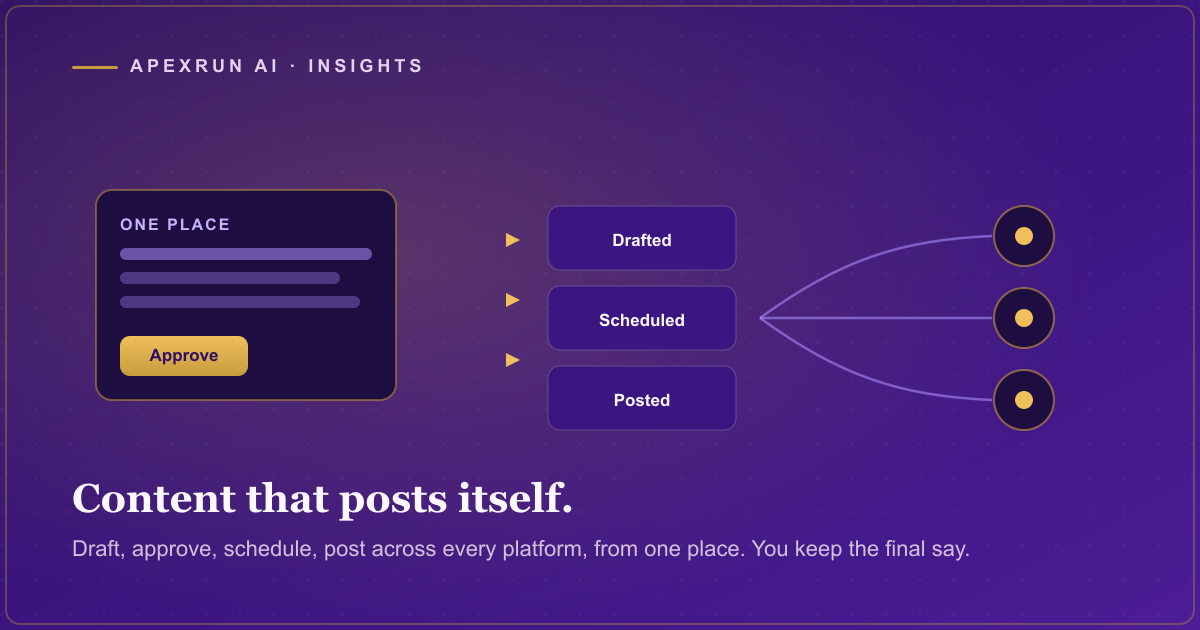
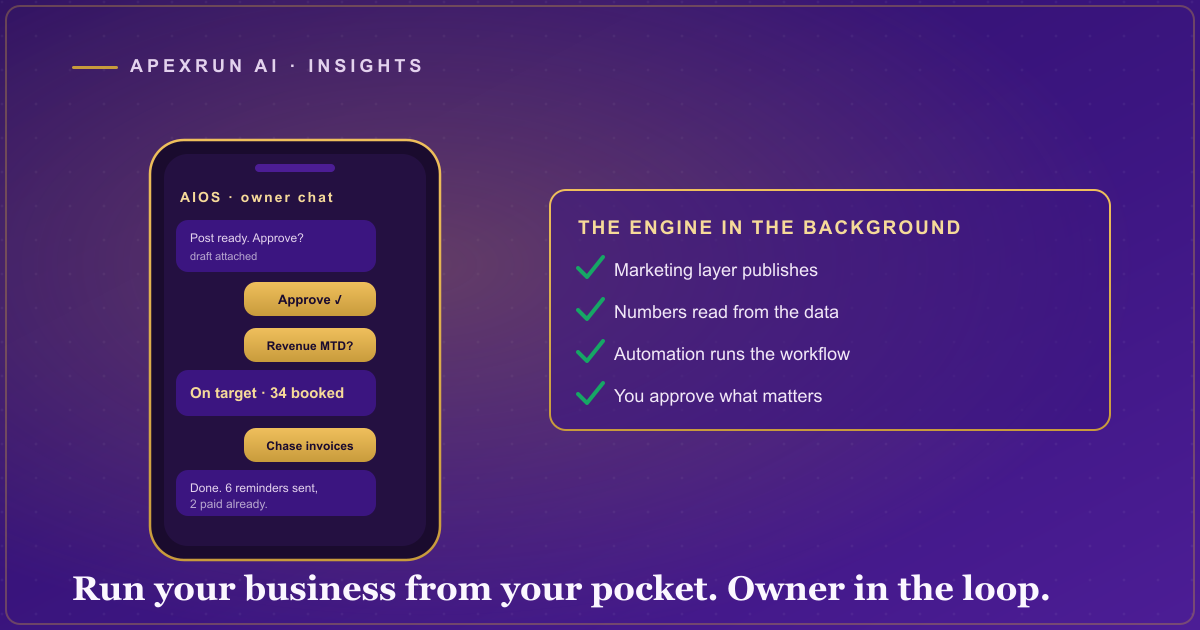
Approve content. The system drafts your social post, your follow-up email, your client update. Instead of logging into three tools, you get a message: here is the draft, approve or edit. You read it on the walk to the car, tap approve, and it goes out. Nothing publishes without your yes, but your yes takes five seconds.
Pull numbers. You want to know where the month sits. You ask the bot, in plain language, and it comes back with the figure: bookings this week, revenue against target, how many leads are still un-chased. No spreadsheet, no report, no waiting for someone to compile it. The number you want, when you want it, from the chat you are already in.
Trigger tasks. You think of something between meetings. Chase the outstanding invoices. Draft the proposal for that lead. Kick off the weekly report. You send the instruction and the system does the work in the background, then reports back when it is done. Your idea does not have to survive until you are back at a desk, because the desk is in your hand.
That is the shape of it. The business runs in the background, and the chat thread is where you stay in command of it without being buried in it.
Owner-in-the-loop is the whole point
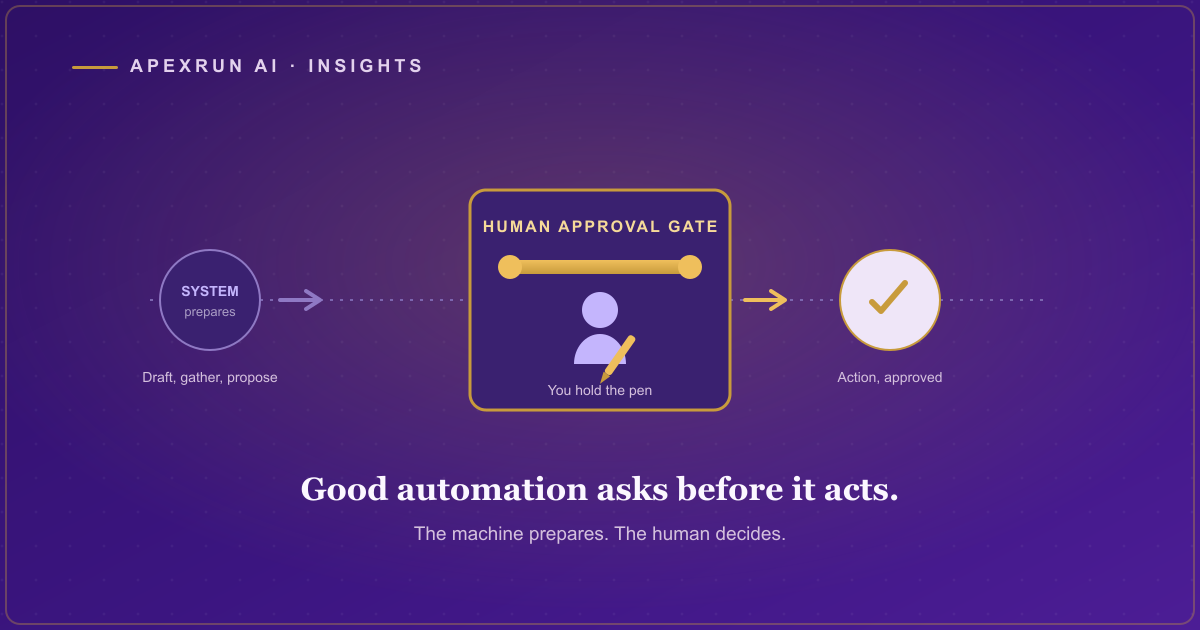
There is a fear underneath a lot of AI hesitation, and it is a reasonable one: that automating your operation means losing control of it, that the system will go and do things in your name that you would never have signed off on. The chat-control model is the direct answer to that fear, because it is built around your approval, not around removing you.
The design principle is simple. The system does the work, and you hold the decisions that matter. Anything with real consequences, a message to a client, money going out, content going public, comes to you as an approval before it happens. Anything routine and safe runs on its own and just reports back. You are not in the loop on everything, because that would defeat the purpose. You are in the loop on exactly the things where your judgment is the point, and out of the loop on the busywork where it is not. I laid out the fuller mechanics of this in the five layers of an AI operating system, where the intelligence layer is the one that keeps the owner in command.
This is the opposite of the runaway-automation nightmare. It is a system that is genuinely powerful and genuinely under your thumb at the same time, because the control surface is a chat you can veto anything from.
Why a chat beats a dashboard
Dashboards fail the same way gym memberships fail. You set them up with good intentions and then you stop opening them, because opening them is a deliberate act you have to remember to do. A business that only reports to you when you log in is a business you are mostly flying blind on.
A chat thread inverts that. It comes to you. The system messages you when there is something to approve, something to flag, or an answer you asked for, in the app you already check dozens of times a day. You do not have to build a habit of visiting it, because it lives where your attention already is. That single difference, push instead of pull, is why the chat interface actually gets used while the dashboard gathers dust.
It also collapses the friction on your side. Approving a post from a dashboard is: stop, find the laptop, log in, navigate, review, click. Approving it from a chat is: read, tap. When the cost of staying in control drops to near zero, you actually stay in control, instead of rubber-stamping a backlog once a week because reviewing things properly was too much hassle.
It is one surface over the whole operation
The reason this works is that the bot is not a standalone gadget. It is the control surface over the entire operating system underneath. When you approve a post, the marketing layer publishes and schedules it. When you ask for a number, the system reads it from wherever the data actually lives. When you trigger a task, the automation layer runs the real workflow. The chat is simple on purpose, and the machinery behind it is doing the heavy lifting.
That is what separates this from a toy chatbot. A chatbot answers questions in a box. This is a live line into a system that is actually running your reports, your invoices, your follow-ups, and your content, with you holding the controls from your phone. If you want the ground-level explanation of what that system is and why “operating system” is the right frame, what an AI operating system is covers it, and the same control model shows up across every one of the industries we work with.
Where to start
You do not get this by downloading a bot. You get it by having an operating system worth controlling underneath it, mapped to how your specific business runs, with the right approval gates in the right places. The chat is the easy part. The system it commands is the thing worth building.
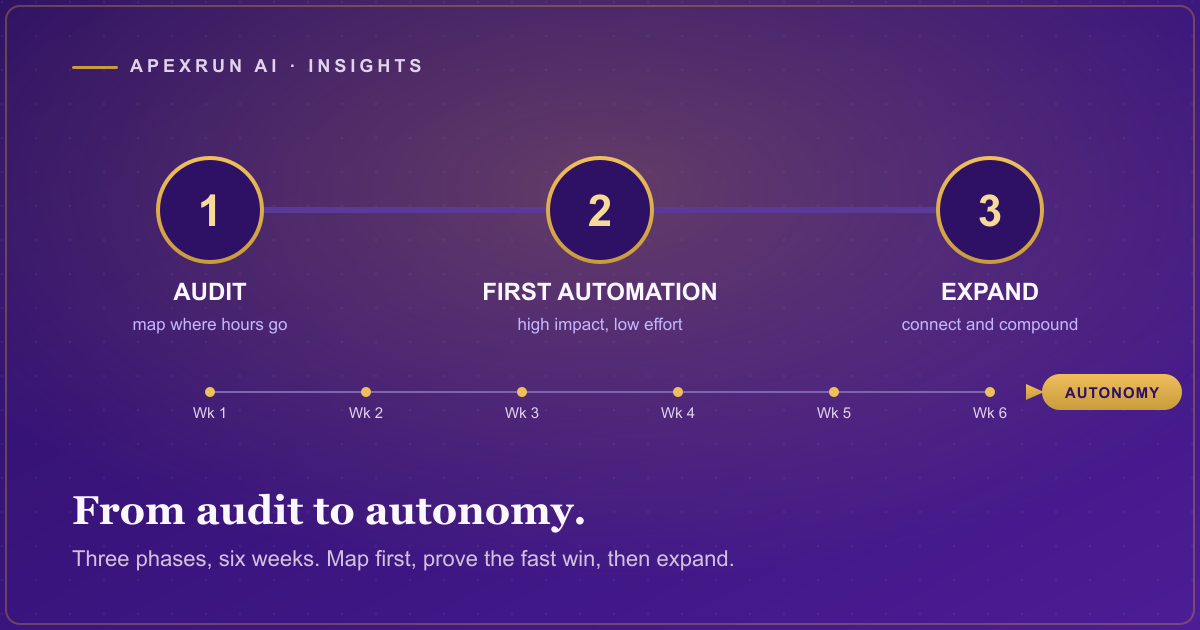
The Free CEO Audit is where that starts. In one hour, direct with the decision-maker, we map your operation, identify what an AI operating system should be running for you, and hand you a prioritized plan, so you know what to build first before you spend a dollar. The payoff at the end of that road is exactly this: your business running in the background, and you steering it from a chat in your pocket, in command without being chained to a desk.