
Most owners have no idea what their own time is worth, which is why the cost of admin work in a small business stays invisible for years. It does not show up on a bill. Nobody sends you an invoice for the three hours you spent reformatting a report or chasing a payment. The cost is real and it is large, but because it is paid in your own hours rather than dollars out the door, it never gets counted. This is a short exercise to make it visible, because you cannot fix a leak you refuse to measure.
I call it a time-value audit. It takes about twenty minutes and it tends to be uncomfortable, which is exactly why it works.
Step one: write down where your week actually goes
Take a normal week, not an idealized one. Over that week, keep a rough log of everything you personally do that takes more than a few minutes. Do not organize it. Do not judge it. Just capture it: answered supplier emails, built the proposal, did the payroll, formatted the client report, chased two invoices, sat in the strategy call, wrote the social post, entered the receipts, took the sales call, fixed the schedule.
Most owners resist this step because they think they already know where their time goes. They almost never do. The tasks that eat the most hours are the small, forgettable ones that do not feel like work, so they never register. The log catches what memory misses.
A quick way to keep it honest: note the time you start and stop each block, even roughly. You are not building a timesheet, you are building evidence. When the week is done, the evidence will argue with the story you have been telling yourself about how you spend your days, and the evidence will win.
Step two: put a dollar-per-hour on every task
Now go down the list and, next to each task, write the honest market rate to have someone else do that specific work. Not your rate. The task’s rate.
Chasing an invoice is maybe a $20-an-hour job. Data entry, $15 to $20. Formatting a document, $20 to $25. Scheduling and inbox triage, similar. Basic social posting, $25 or so. These are the numbers you would pay a competent person to do exactly that task, and they are deliberately modest, because the work is genuinely modest. There is nothing wrong with the work. It simply does not require you.
Then tag the other kind of task. Winning a client. Making the call that carries real consequences. Diagnosing the hard problem. Setting the strategy. Building the relationship that becomes three years of revenue. Put your real rate next to those, whatever it honestly is, whether that is $200, $400, or more once you account for what your involvement is actually worth to the business.
The list will split fast, and it will not be subtle. A cluster of tasks sitting at $15 to $25, and a much smaller cluster sitting at ten or twenty times that.
Step three: total the leak
Add up the hours sitting in the low-value cluster, the sub-$25 pile. Then look at the number.
When owners actually run this, the low-value total usually lands somewhere between 20 and 30 hours a week [ESTIMATED, based on the pattern we see, not a survey]. Half the working week, or more, spent on work you would pay someone $20 an hour to do, performed instead by the single most expensive person in the business. That is the cost of admin, and it was there the whole time. You just never put it on one page.
Now do the arithmetic that makes it sting. Say the leak is a conservative 20 hours, and say the highest-value work those hours displace is worth $200 an hour to you, again on the low end. That is $4,000 a week of your capacity spent on tasks worth a fraction of it [ESTIMATED, using your own inputs]. Even if you only recovered half those hours and only sold half of what you recovered, the number is still large enough to change how you think about the year. The leak does not announce itself, but it compounds every single week you leave it running.
Why this happens to good operators
This is not a discipline problem. It happens to hard-working, competent owners, and it happens for a simple structural reason: the admin has to get done, you are the person who is always there, and hiring feels expensive and slow. So the work defaults to you. Every time. The high-value work gets squeezed into whatever hours are left, which is why owners feel busy and stalled at the same time. The busy is real. It is just aimed at the wrong pile.
There is also a false economy hiding in “I will just do it myself, it is faster.” It is faster in the moment and ruinous over the year. Every time you absorb a $20 task to save the friction of handing it off, you are paying for it with a $200 or $400 hour you will never get back, and you are reinforcing the habit that keeps the whole leak in place. The task feels free because no money changes hands. It is the most expensive way you spend your week.
Working harder does not fix it, because the admin grows with the business. Hiring helps but is partial and expensive, and a person still hands the tedious-but-fiddly parts back to you because they need your input to begin. The structural fix is to stop being the default owner of the low-value pile in the first place.
What to do with the number
Once you have your leak total, you have something most owners never get: a measured, dollar-tagged map of exactly where your time is being wasted, ranked. That map is the whole starting point, because it tells you what to automate first, in the order that pays back fastest.
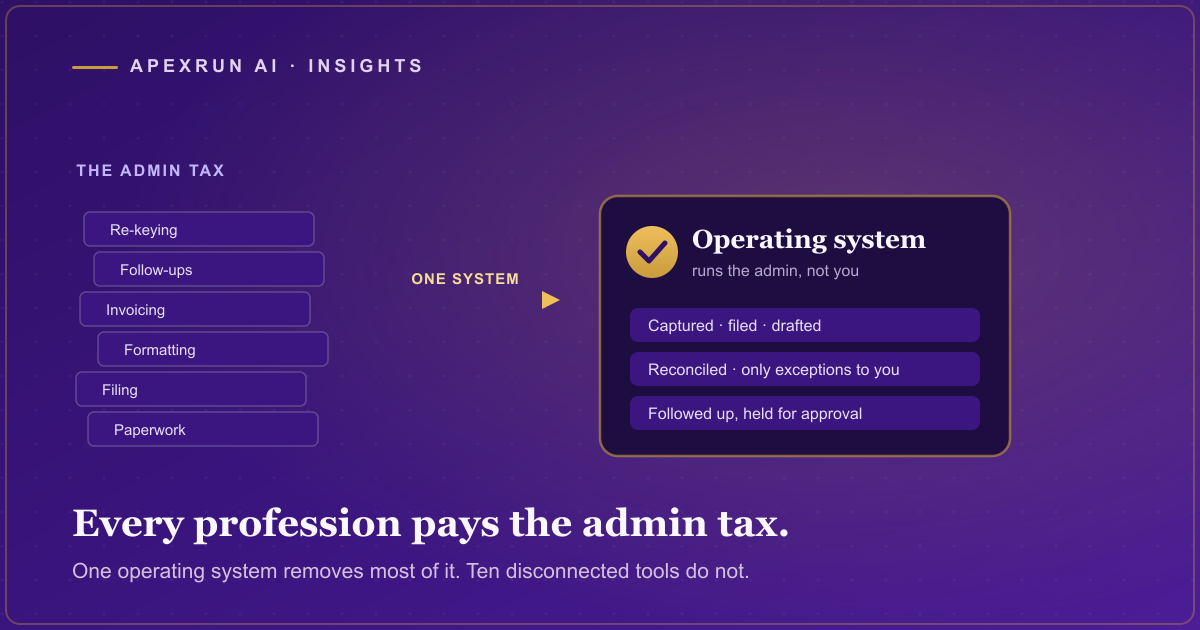
This is precisely what an AI operating system is built to absorb: the recurring, sub-$25 work that fills the leak, run as one connected flow with your approval where it matters, so those hours move back to the work that only you can do. If you want to see how that plays out in your specific line of work, the industries breakdown covers it by sector.
You can run the audit yourself this week, and you should. If you would rather have it done properly, the Free CEO Audit is that exercise run with you: in one hour we map where your time actually goes, tag the leak, and hand you a prioritized plan for closing it, so you know exactly what to fix first before you spend a dollar fixing anything.