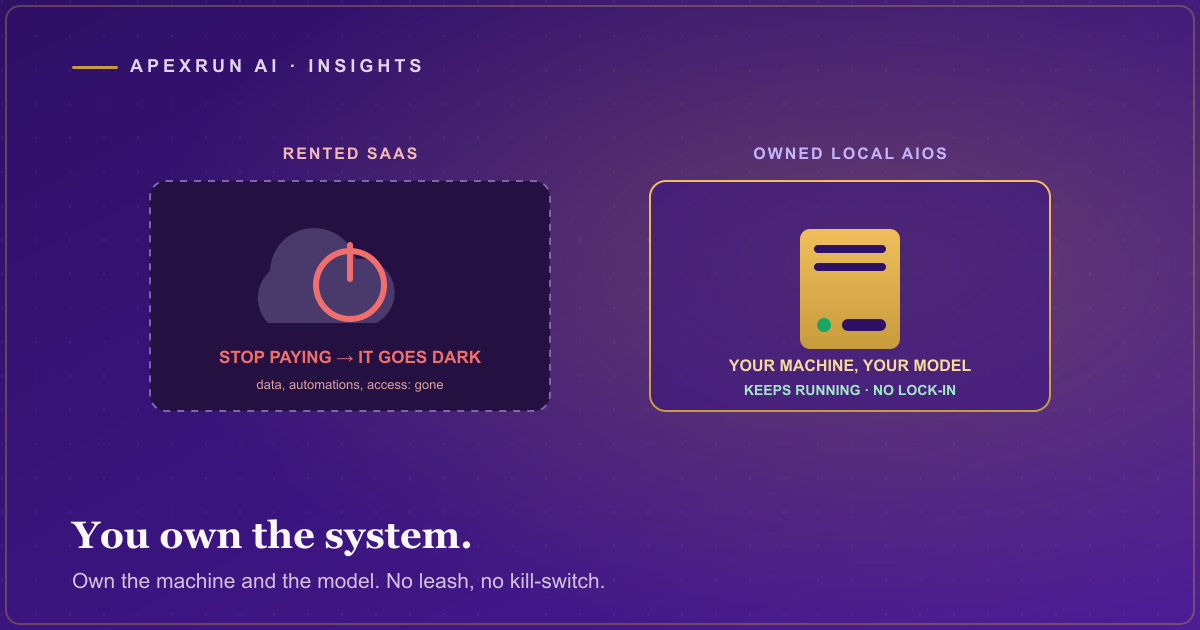
Ask a question almost nobody asks their software vendor: what happens to everything I have built if I stop paying you? With most business software the answer is blunt. It stops. The subscription lapses, the login dies, and the automations, the data, the workflows you came to depend on go dark, because you were never the owner, you were the tenant. When you own your AI system instead of renting it, the answer flips completely. Stop paying and the machine is still on your desk, the model is still on it, and your automation keeps running, because you own the infrastructure rather than borrowing access to someone else’s. That single difference, owned versus rented, is one of the strongest reasons to run a local AI operating system, and it is the part the SaaS industry would rather you not think too hard about.
Rented software is a leash you do not feel until it pulls
The SaaS model feels reasonable while everything is going well. You pay monthly, you get access, it works. What is easy to miss is that you have quietly built your operation on top of something you do not control and cannot keep. The vendor can raise the price, and you pay because migrating off is painful. They can change the product, sunset the feature you depend on, or get acquired and shut down, and you absorb it, because your business now runs on their servers under their terms. The more essential the tool becomes, the more leverage they have over you, which is the exact opposite of the position a business owner wants to be in.
This is lock-in, and it is not an accident, it is the business model. The value to the vendor is precisely that you cannot easily leave. You are not a customer so much as a recurring dependency, and the switching cost they have engineered is the fee you pay for the crime of wanting to keep your own operation running.
Owned infrastructure changes who holds the leverage
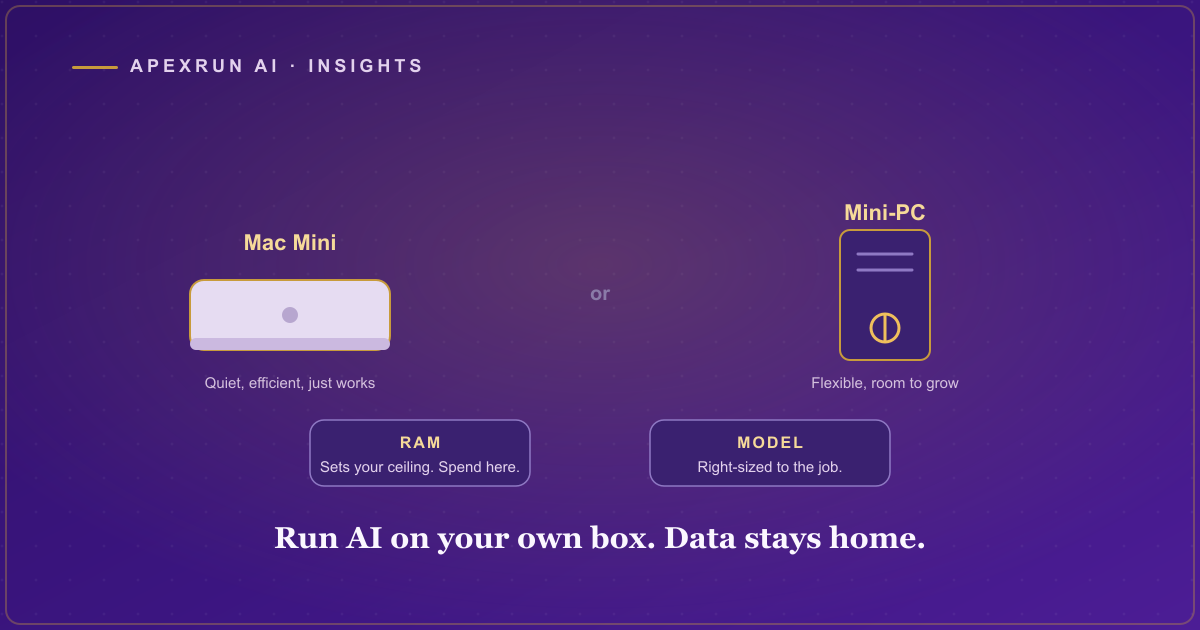
A local AI operating system inverts the whole arrangement. The system runs on a machine in your office, on hardware you own, with the AI model running on that hardware. Your data lives on it. Your automations run on it. There is no monthly login that switches everything off if a payment fails, because there is no remote server holding your operation hostage. It is yours, the way a truck or a tool or a building is yours.
Play out the scenario the SaaS vendor never wants you to picture. You stop paying. With rented cloud software, your operation goes dark that day. With an owned local system, nothing happens, because the machine is on your desk and the model is on the machine. The automations keep running. You keep custody of your data and your workflows. You are not renting the ability to operate your own business, you own it. That is a fundamentally different and stronger position, and it is available.
I am being straight about the nuance here. Ongoing improvement, support, and new capability are worth paying for, and a good partner earns that. The point is not that you never pay anyone anything. The point is that the core infrastructure, the machine and the model your business runs on, is an asset you own outright, not a switch someone else can flip off. The relationship becomes a partnership you choose to continue, not a dependency you cannot escape.
The economics are better too, and they run the right direction
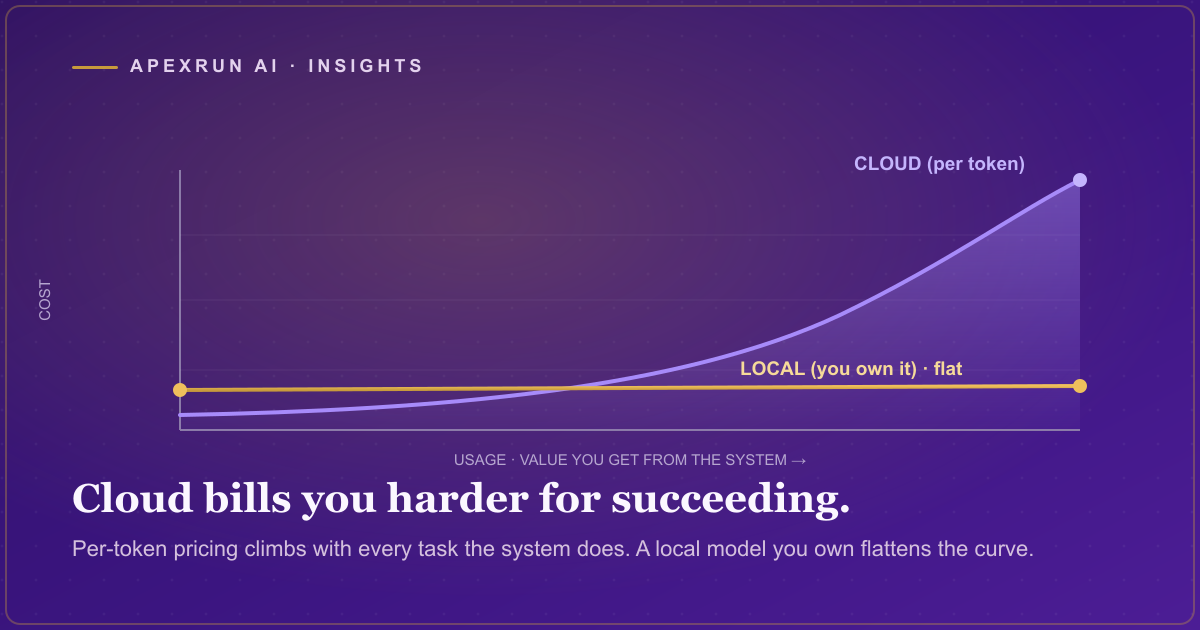
Ownership does not just protect you, it usually costs less over any real time horizon. Cloud AI meters every request. The more your business uses it, and a whole-operation system uses it constantly, the more you pay, forever, with the bill scaling up exactly as you succeed. You are renting compute by the token, and success makes rent more expensive.
A local model on your own hardware flips that curve. You run your entire workforce of automations for the cost of a machine you already bought and the electricity to run it. The heavy, high-volume work, the drafting, the summarizing, the routine processing, runs at effectively zero marginal cost, because it is running on your own box rather than someone else’s meter. I laid out the full math on this in zero token cost: the economics of running AI on your own machine, and the short version is that owned infrastructure gets cheaper per unit of use as you use it more, which is the opposite of how rented cloud AI behaves.
Ownership and privacy are the same move
There is a second payoff that comes free with owning the machine, and for a lot of businesses it is the decisive one. If the model runs on your hardware in your office, your sensitive data never has to leave the building. Client files, financial records, health information, privileged material, none of it gets shipped off to a cloud service in another country to be processed. The same architecture that means you keep the system if you stop paying also means the data never crosses a border into someone else’s data centre. I made the fuller privacy case in private by design: why on-prem AI beats the cloud for sensitive work.
So the local model is not one benefit, it is a cluster of them arriving together: you own the asset, you dodge the lock-in, you kill the per-token bill, and you keep custody of your data. For regulated and confidentiality-sensitive businesses, that combination is not a nice-to-have, it is the thing that makes deploying AI safe and sane in the first place. It shows up across nearly every one of the industries we work with, because the businesses with the most to gain from automation are often the ones with the most sensitive data and the least appetite for being locked into a foreign cloud.
The question to actually ask a vendor
Next time someone sells you AI software, ask the uncomfortable question directly. If I stop paying, what happens to my automations, my data, and my ability to keep operating? Watch how they answer. If the honest answer is “it all stops,” you are being sold a leash, however nice the product is. If the answer is “you keep the machine and the model and it keeps running,” you are being offered an asset. Those are very different deals wearing similar marketing.
An AI operating system, done right, is the second kind. It is infrastructure you own, running your business on hardware in your building, under your control, with no remote kill-switch and no per-token meter counting your success against you.
The Free CEO Audit is where you find out what that would look like for your specific business. In one hour, direct with the decision-maker, we map what an owned local operating system could run for you and hand you a prioritized plan, so you know what to build first before you spend a dollar, and so that what you build is an asset you own rather than a subscription you are trapped in.