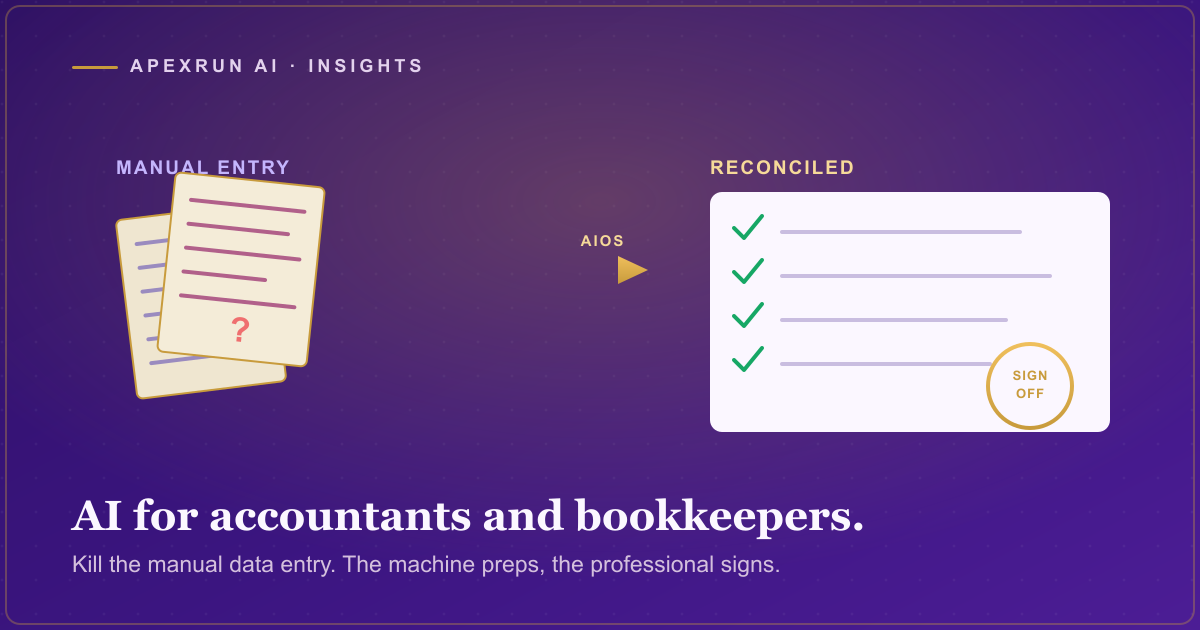
Ask an accountant what they trained for and you will hear about advising clients, structuring their affairs, catching the thing the software missed, and standing behind the numbers when it counts. Then watch the actual week. It is receipts. It is chasing a client for a missing invoice for the fourth time. It is re-keying figures from a bank feed that almost imported cleanly. AI for accountants and bookkeepers is not about replacing the judgment you built a career on. It is about killing the manual data entry that sits between you and the work you are actually paid for.
The dirty secret of the profession is that a large share of a firm’s hours go into moving data from one place to another and checking that it landed. That work is necessary. It is also the lowest-value thing a qualified person can do, and it is exactly the kind of work a well-built system handles without complaint, at 2 in the morning, without a coffee break.
Where AI for accountants actually earns its keep
Four jobs eat the calendar in most Ontario accounting and bookkeeping practices. An AI operating system, what we call an AIOS, can take a serious bite out of each one.
Reconciliation. Matching transactions against the ledger is pattern work, and pattern work is what machines are good at. A system watches the bank feed, matches the clean transactions automatically, and surfaces only the handful that do not tie out. You stop scrolling through 400 lines to find the 6 that need a human. You look at the 6.
Categorization. Coding expenses to the right account is repetitive and rule-shaped. The system learns how you code, applies it consistently, and flags anything it is unsure about instead of guessing silently. The result is not just faster, it is more consistent, because it does not get tired and it does not code the same vendor three different ways across three months.
Client requests. The invisible time-sink. “We are missing your March statement.” “Can you confirm this $2,400 charge?” A system runs that back-and-forth on a schedule, chases the missing documents, files what comes back in the right place, and only pulls you in when a client says something that needs a real answer. The chase stops being your job.
Report and letter drafting. Month-end packages, management summaries, the covering note that explains the variance. The system drafts these from the finished numbers so you are editing a strong first draft instead of staring at a blank page at 9 PM. First draft in seconds, your judgment on top.
The line that matters: safe to automate versus sign-off required
Here is where most AI conversations for accountants go wrong. They pitch full automation, and any accountant with a licence and a functioning sense of risk correctly walks away. That is the wrong frame. The right frame is a clear line between what runs on its own and what a human signs.
On the safe side sit the mechanical, reversible, high-volume tasks: matching clean transactions, pulling data together, drafting a document, chasing a missing file, flagging an anomaly. If the system gets one of these slightly wrong, you catch it in review and nothing has left the building. The cost of an error is a correction, not a filed mistake.
On the sign-off side sit anything that carries professional risk: the final numbers that go to a client or the tax authority, a judgment call on treatment, an assurance opinion, advice with money or compliance riding on it. The system prepares the work. You approve it. Your name still goes on it, and it should.
This is not a compromise, it is the correct design. Good automation in a regulated profession is not the machine acting alone. It is the machine doing the preparation and a qualified human holding the pen at the end. Every place a mistake would be costly gets a human approval gate. Everywhere else, the work just gets done. If you want the fuller picture of how these pieces stack, what an AI operating system actually is lays out the layers underneath this.
Why the data-residency question is not optional for your firm
There is a second reason accountants hesitate on AI, and it is a good instinct. You hold your clients’ entire financial lives. Sending all of that to a cloud AI service in a US data centre is a real exposure, not a hypothetical one, and it is exactly the kind of thing that gets raised in a professional-conduct review.
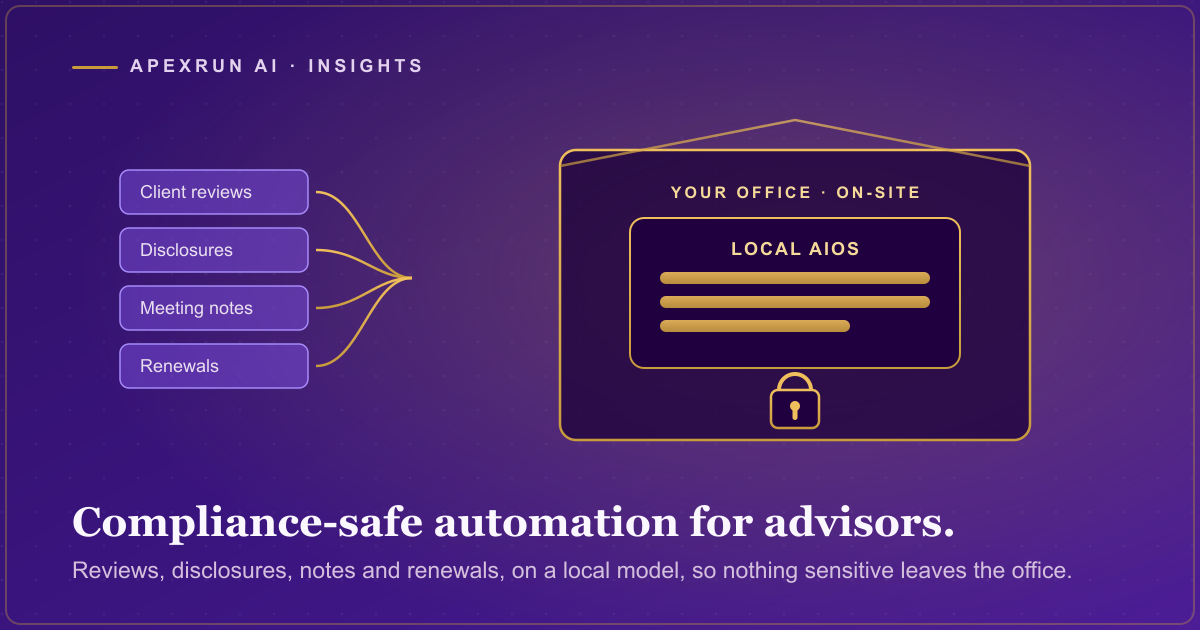
An AIOS does not have to work that way. It can run on a machine in your own office, on a local model, so client financials never leave your building and never cross the border. You get the automation and you keep custody of the data. For an Ontario firm thinking about PIPEDA and client confidentiality, that is often the detail that moves AI from “interesting but risky” to “actually deployable.” The efficiency was always the draw. The data staying in your office is what makes it safe to turn on.
What this frees you to do
Play the math forward. Say manual data entry, reconciliation cleanup, and document chasing eat 12 hours of your week [ESTIMATED, varies by firm]. If a system absorbs the bulk of that and hands you back 8 hours, those hours do not vanish. They move to advisory work, to onboarding the clients you have been too buried to take, or to going home before 8 PM during a normal month instead of only in the summer.
The firms pulling ahead in accounting are not the ones with more staff grinding harder. They are the ones that stopped paying qualified people to do machine work. Your competitors down the street in the same profession are making this choice right now, and the gap it opens compounds quietly, month over month, the same way it does across every industry we work in.
Where to start, honestly
Do not buy a pile of AI tools and hope they add up. A drawer of disconnected apps is how firms end up with more chaos, not less. The move is to map your firm’s actual workflow, find where the manual data entry is heaviest, and automate that first, with the sign-off gates built in from day one.
If you want to see this applied to your practice specifically, the same clean split shows up in adjacent professions too, like the reclaimed hours story for professional-services firms. The pattern is identical: the machine preps, the professional signs.
That mapping is exactly what the Free CEO Audit does. In one hour, direct with the decision-maker, we walk through where your firm’s hours actually go, identify the data entry and reconciliation work an AIOS can take off your plate, mark clearly what stays behind a human sign-off, and hand you a prioritized plan, so you know what to build first before you spend a dollar building it. You will leave knowing exactly what the manual work is costing you.