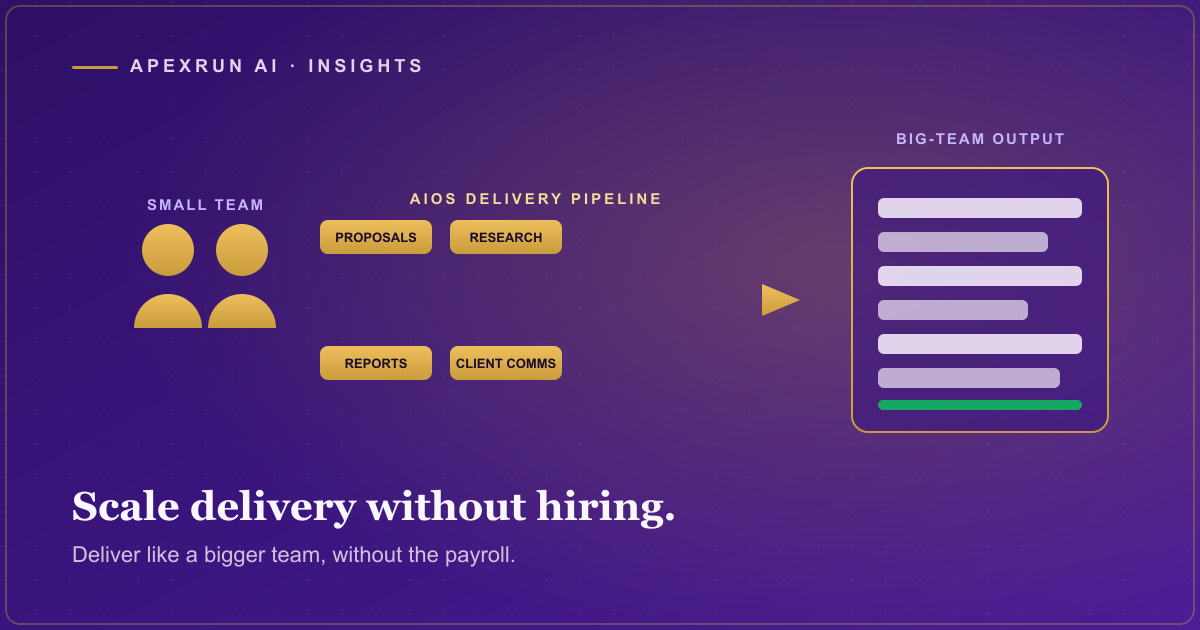
Consulting and agency work has a structural problem that no amount of talent fixes on its own. Your revenue is capped by delivery capacity, and delivery capacity is people, and people are the most expensive, slowest, and riskiest thing you can add. So you hit a ceiling. You turn down work, or you take it and burn the team, or you hire ahead of the revenue and pray the pipeline holds. AI for consulting firms and agencies changes the shape of that ceiling, because it lets a small team deliver the volume of a much larger one without the headcount that usually comes with it.
I want to be precise about what that means, because the market is drowning in vague promises about AI. This is not about a chatbot writing your emails. It is about putting an operating system underneath the repetitive production work that eats your delivery hours, so your senior people spend their time on the judgment and the relationships, which is the only part clients actually pay a premium for.
What AI for consulting firms actually automates
Look at where a consulting or agency week disappears. It is almost never the strategic thinking. It is the production layer around it.
Proposals and scopes. Every new engagement starts with a document that pulls from past proposals, restates your methodology, tailors the deliverables, and prices the work. You have written a version of it fifty times. An AI operating system drafts it from your inputs and your own library of past work, so you edit a strong draft in fifteen minutes instead of building it from a blank page over two hours.
Research and synthesis. The unglamorous middle of most engagements is gathering, reading, and summarizing: market scans, competitor teardowns, interview notes, the pile of source material a recommendation has to stand on. The system does the first-pass gathering and synthesis and hands you a structured brief, so your analyst starts from a draft instead of a blank folder.
Reporting and client updates. Status reports, monthly recaps, the deck that repackages work you already did. This is pure overhead, it produces nothing new, and it recurs on every account forever. The system assembles it from the live project data and drafts the narrative, so you approve instead of produce.
Client communications. The follow-up after a call, the check-in nobody has time to send, the nudge on the outstanding approval. These are the touches that keep accounts warm and dropping them quietly costs you renewals. The system runs the cadence in your voice and holds anything sensitive for your sign-off.
None of this removes the consultant. It removes the production drag around the consultant. That is the whole point.
Why this beats hiring, and where it does not
The instinct when you are capacity-constrained is to hire. Sometimes that is right. But a hire is a fixed cost that shows up whether the month is busy or slow, needs onboarding, needs managing, takes holidays, and still hands the tedious-but-necessary work back to you because it needs your input to start. You are not just buying labour, you are buying overhead and management load.
An AI operating system carries a different cost curve. It absorbs the recurring production work at a cost that does not scale with headcount, it is available at 11 PM on a deadline, and it does the fiftieth proposal with exactly the same quality as the first. For the production layer, that is a better deal than a junior hire, and it is available immediately.
Where does the human still win? Anywhere judgment, taste, trust, and accountability carry the value. The client relationship. The creative leap. The hard call on strategy. The moment you look someone in the eye and tell them the uncomfortable truth they hired you for. You do not want a system doing those, and it will not. The right split is simple: automate the production, keep the judgment human, and stop paying senior rates for work that was never senior. I made the fuller version of this argument in stop doing $20 work in a $400 seat, and it lands hardest in professional services, where your billable rate makes every hour of production drag absurdly expensive.
What “scale delivery without hiring” looks like in practice
Run the math on your own shop. Say a two-person agency spends twelve hours a week between them on proposals, reporting, and client comms. If an operating system absorbs the bulk of that and hands back eight hours, those hours do not vanish into more admin. They go to selling the next engagement or servicing one more account. Eight hours a week is a meaningful fraction of another client’s worth of capacity, funded by work you already had, with no new salary attached.
Do that across a year and the compounding is the real story. The capacity you free this quarter funds the growth that fills next quarter, which frees more capacity again. You start pulling away from competitors who are still trading hours for revenue one body at a time. That is not a productivity tweak, it is a different growth ceiling.
There is a positioning benefit too, and consultants underrate it. A firm that delivers faster, responds sooner, and never drops a follow-up simply reads as more competent to the client. The operating system does not just save you money, it makes your delivery look sharper, which is the thing that wins renewals and referrals.
The version built for how agencies actually run
Generic AI advice ignores that agencies have their own operating rhythm: a book of accounts, recurring deliverables, a proposal-to-delivery pipeline, and a brand voice that has to stay consistent across everything that goes out. A capable system maps to that rhythm rather than fighting it. We built a version specifically around this delivery model, and you can see how the pieces fit in the digital agency command book, which walks through the specific automations that apply to a client-services shop.
If you want the broader frame first, what an AI operating system is explains why an operating system beats a drawer of disconnected tools, which is the trap most agencies fall into when they buy AI point-solution by point-solution and end up doing more coordination, not less.
Where to start
You do not scale delivery by buying more tools and hoping they add up to leverage. You scale it by mapping where your delivery hours actually go, finding the production work that is capping your capacity, and automating that first, in the order that frees the most senior time per dollar.
That mapping is exactly what the Free CEO Audit does. In one hour, direct with the decision-maker, we walk through your delivery pipeline, identify what an AI operating system can take off your senior people, and hand you a prioritized plan, so you know what to build first before you spend a dollar building it. For a consultancy or an agency, the number that comes back is usually the equivalent of a hire you were about to make and now do not have to.